

Fertiliser market analysis
Our analysis of the fertiliser market in Poland shows how closely the sector is tied to global trends, fluctuations in raw material prices and EU regulations. In recent years the market has faced the energy crisis, the war in Ukraine and pressure from the European Green Deal. As a result, Polish producers and farmers face uncertainty, but there are also growing opportunities to develop innovative solutions and organic segments.
The full report on this market in PDF, delivered in 3 business days.
Order the scan01
How big is the fertiliser market globally and in Europe?
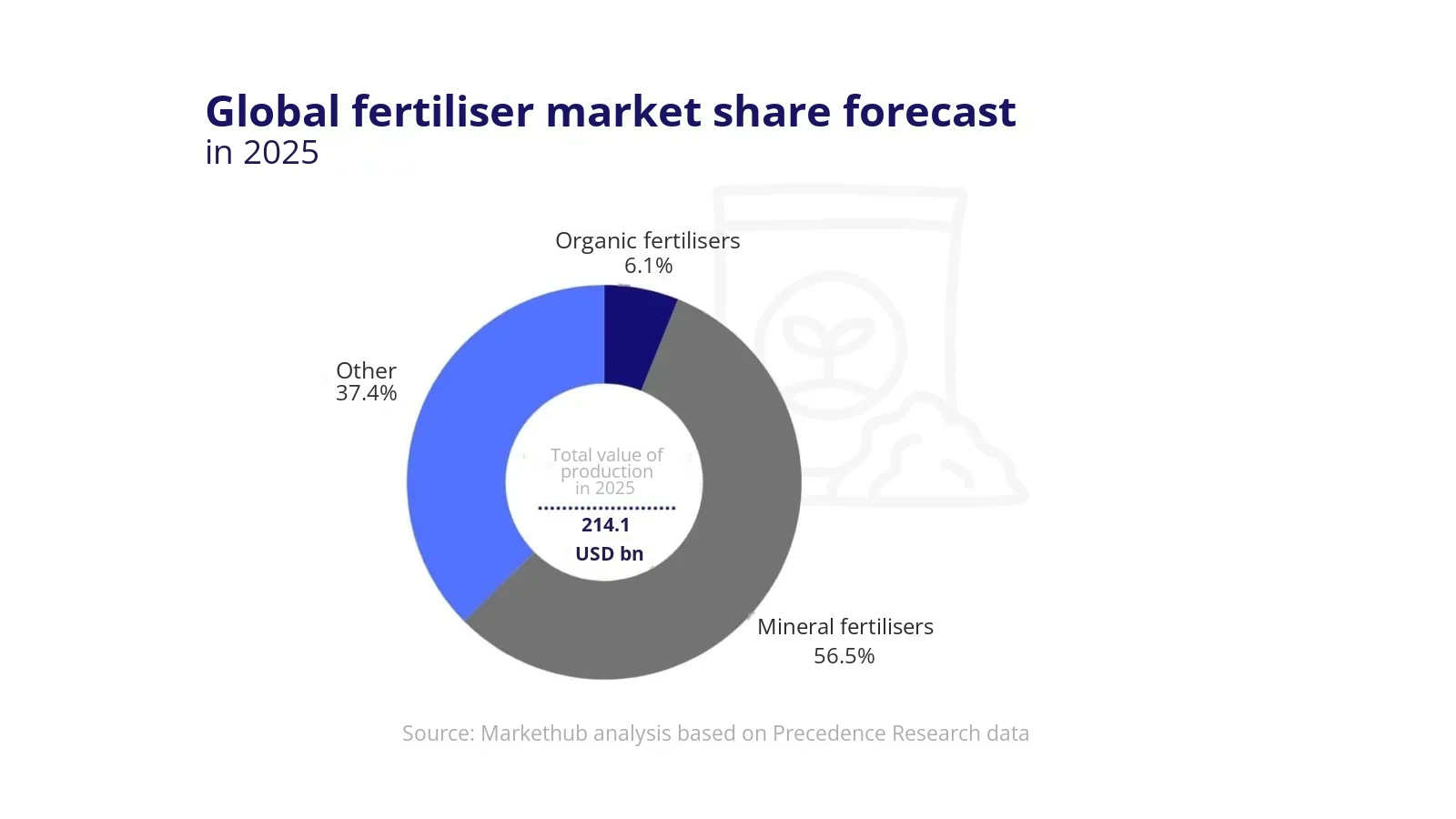
The global fertiliser market was worth USD 214 bn in 2025 and is expected to grow to USD 277 bn by 2034 (CAGR: 2.9%). Mineral fertilisers have the largest share (56.5%), while organic fertilisers account for just 6.1%, although they are growing the fastest (CAGR 5.9%). In Europe, where the market is worth USD 55.3 bn in 2025, rapid growth to USD 72.3 bn by 2030 is forecast (CAGR: 5.5%). At the same time, the European Union is reducing the use of mineral fertilisers under the Green Deal and the Farm to Fork strategy.
"Agriculture in Europe is moving towards greater precision and sustainability. Traditional fertilisers will remain important, but their role is gradually changing", MarketHub analysts stress.
Fertiliser and raw material prices
Forecasts for 2025–2026 point to moderate increases, especially for nitrogen fertilisers, which depend on gas prices. Stabilisation is expected in 2026.
02
How have fertiliser prices and consumption changed since 2022?
After the 2022 price spike, most fertiliser prices fell gradually in 2023 and stabilised in 2024 below the peak but above pre-crisis levels, while consumption, especially of nitrogen fertilisers, is recovering.
After the sharp price spike in 2022, caused among other things by the gas shock, supply chain disruptions and geopolitical uncertainty, 2023 brought a gradual fall in the prices of most fertilisers. In 2024, prices stabilised at levels significantly lower than at the peak, though still higher than before the crisis. Consumption, especially of nitrogen fertilisers, is recovering as the grain-to-fertiliser and rapeseed-to-fertiliser price ratios improve. Controlled-release fertilisers and products with inhibitors are taking a growing share of sales. They allow more effective dosing and lower nitrogen losses.
03
What are the trends in the fertiliser industry?
The main trends are precision agriculture, controlled-release fertilisers and nitrogen inhibitors, biostimulants and biofertilisers, digitalisation of services and green technologies.
Main development trends:
04
How does climate change affect the fertiliser market?
Climate change is increasing demand for resilience-boosting fertilisers:
In the longer term, organic and mineral fertilisers that improve soil structure and water retention are gaining importance.
05
What is the outlook for the fertiliser market in Poland?
The fertiliser market in Poland faces a period of transformation. On the one hand, regulatory restrictions and volatile raw material prices increase cost risk; on the other, the development of innovation and sustainable solutions creates room for new business models.
Our analysis indicates that success will come to producers and distributors who combine economic efficiency with the requirements of sustainable agriculture.
Want to understand the fertiliser market in Poland and Europe better? Get the full report Fertiliser Market in Poland. Analysis, Prices, Risks, Trends and Development, which provides detailed data, forecasts and practical recommendations.
What is the outlook for the fertiliser market in Poland?
A ready-made PDF report from Market Scan by MarketHub: market size, key players, trends and data sources. We email it to you within 3 business days after payment.
Want to use this brief?
You can quote the data if you name the source and, where possible, link to our website. Use this credit line:
Source: MarketHub, "Fertiliser market analysis", markethub.pl, 09.2025