












We show client names and logos only with their direct consent. Most of our projects are covered by a confidentiality clause.
Expert commentary in every report
Every competitor analysis includes comments from industry, scientific and business experts. They assess your competitors’ strengths and weaknesses and say what the findings mean for your position in Poland.
When do foreign companies order a competitor analysis in Poland?
It usually starts with a move by a local competitor, less often with planning, although that is when the analysis gives you the most time to react.
Polish producers win on price
Polish manufacturers undercut you in your home market or in Poland. We check their costs, margins and capacity, and whether the price level can last.
Your Polish subsidiary is losing share
We compare it with local players: financials, offer, prices and channels, in a report you can show to head office.
A new player has entered the market
We find out who it is, who owns it, what it offers, which channels it sells through and which customers it targets.
Before entering Poland
You want to know who you will compete with, how strong they are and where there is a gap before you commit budget.
Acquisition or investment
You need to assess the competitors of a target company: their scale, growth and financial health, from Polish registers.
New product launch in CEE
Before you set prices and positioning, we compare competitors’ offers and price lists item by item.
What does a competitor analysis in Poland include?
For each competitor on the list we check 10 areas. For each area we use standard sources (Polish names in brackets) and from each we draw a conclusion for your company.
What you may be missing without local knowledge of Poland
Polish registers are open to anyone. Reading them correctly and filling the gaps they leave takes local know-how. These are the gaps we fill most often for foreign clients.
MarketHub has researched Polish companies since 2006. Our analysts read the sources in Polish, talk to the market in Polish and give you the result in English, ready for head office.

Which competitors you can see
How much a Polish company has to disclose depends on its legal form. Some competitors publish full accounts every year, others publish none. We know where to look for each one and how to estimate the rest.
Documents in Polish
Financial statements are filed in Polish, in PLN and often in an electronic format that has to be converted before you can read it. We work with the originals, so nothing gets lost in translation.
Figures you can compare
Polish rules allow different income statement layouts and shortened statements for smaller firms. We convert them into the same ratios, so you compare competitors on equal terms.
Who stands behind a company
Owners, group links and beneficial owners sit in different registers. We connect them, so you can see when a small local player belongs to a larger group.
What no register shows
Prices, margins, customers and plans are not in any register. We get them from offers, tenders and interviews with Polish distributors and buyers.
How fresh the data is
Figures for the last financial year usually appear in the register around mid-year, and some companies file late. We tell you how current each figure is and mark every estimate.
Without this background it is easy to compare the wrong numbers or miss a competitor altogether. If you would rather have a team that works with Polish sources every day, request a quote.
Sample competitor profile
This is what one company profile looks like in the report. Every profile has the same sections, so competitors are easy to compare.
Company card
Registration data, owners, links, headcount and locations.
Financials
Revenue, result, margin and debt over recent years, compared with your company.
Offer and prices
Products, variants, price levels and trade terms.
Sales and marketing
Channels, distributors, communication, SEO and AI visibility.
Strengths and weaknesses
Where it is dangerous and where you can overtake it.
Conclusions for you
What to do in response and which moves to watch for.
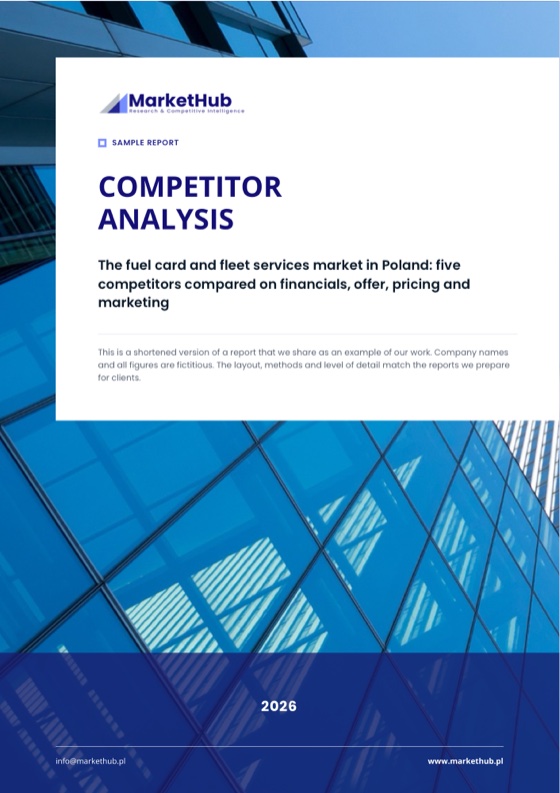
Download a sample competitor analysis report
This shortened report shows what our analysis looks like: a competitor profile, a comparison of offer, pricing and marketing, and a 10-area matrix. Company names and all figures are fictitious, while the layout and level of detail are the same as in the reports we prepare for clients.
- PDF: shortened competitor analysis report
Enter your work e-mail and company. We will send the link to the report straight away.
How we research your competitors
It usually starts with a move by a local competitor: a price cut, a new product or a customer you lost. In the first meeting we agree which companies to cover, typically 5 to 10, and what your board needs to know about them. They can be Polish firms or companies from the EU, the UK or the USA that sell in Poland. The report then sticks to that list.
We read competitors' financial statements from KRS, the Polish company register: revenue, margins, debt and how they have changed over recent years. Offers and prices are compared line by line. We also look at how each company reaches customers: the channels it sells through, its marketing, how it ranks in Google and what AI assistants say about it. If you want to see their customer service from the inside, our analyst can contact a competitor as an ordinary customer (mystery shopping).
We use only open sources and public registers, and we never tell anyone who we work for. You receive a report with company profiles, their strengths and weaknesses and recommended counter-moves, and we go through the findings with you on a follow-up call. Projects take 15 to 20 days, and we send the scope and price within 72 hours.
What you get
Every report is different because we set the scope around your decision. The items below are examples.
In the report:
In what form:

Every report ends with a presentation of the results and recommendations for your board.
Questions are answered by the analysts who collected the data. Industry experts’ comments come in the same report.
How long does it take?
A competitor analysis of 5–10 companies usually takes 15–20 working days from when you accept the quote. Timings are indicative. You get the exact schedule in the quote.
A longer list, competitors outside Poland, a mystery client module or companies that do not publish financial statements extend the project. If it is urgent, say so in your enquiry and we will narrow the scope to what matters most.
Company Check or competitor analysis?
Sometimes checking one company is enough. This is how to choose:
Polish Company Check
You need to verify one Polish company before you sign a contract, appoint a distributor or pay an advance: registration, owners, financials and red flags.
See Polish Company CheckCompetitor analysis
You need to compare 5–10 companies with each other and with you: financials, offer, prices, channels and marketing, with recommendations on how to respond.
Request a quoteOne-off analysis or monitoring?
An analysis gives you a full picture of competitors at one point in time. Monitoring shows what changes. Many companies start with an analysis as a baseline and then move to monitoring.
Compared with the alternatives
There are several ways to research competitors in Poland. Each has its place:
What this does not cover
Some things we do not do, whoever asks:
Nothing unlawful
We do not pretend to be someone else, we do not access closed systems and we do not record conversations without consent.
No trade secrets
We do not obtain confidential information or persuade employees of competitors to disclose it.
No legal advice
If the analysis raises legal questions, for example on competition law or contracts, take them to a law firm.
Case studies

Software house from Kraków: corporate car sharing
A comparison of seven suppliers of corporate car sharing apps: features, and subscription and hardware prices calculated for a fleet of 78 cars.
Read the case study
Ayming Polska: ESG advisory
A comparison of advisory firms and ESG reporting software providers: services, marketing and prices, plus lists of companies from Spain and Belgium.
See case studies
Footwear manufacturers in Turkey
As part of an entry strategy we compared the ten largest Turkish manufacturers: product range, communication channels and prices in five footwear categories.
Read the case studyWho will prepare your competitor analysis
Our analysts prepare the research. You have one contact person throughout the project.

Patrycja Hrabiec-Hojda
Founded Infobrokerska in 2006, one of the first information brokerage firms in Poland, which grew into MarketHub. Has led analytical projects for 20 years and runs training in open-source intelligence (OSINT). Co-authored the professional standards for information brokers for the Polish Ministry of Labour.

Dr Łukasz Brzeziński
PhD in economics. Prepares advanced market reports and analyses. Assesses market potential, writes business plans and values technologies, patents and know-how.
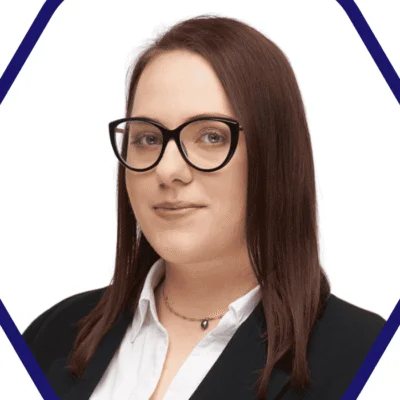
Katarzyna Kucia
Prepares market analyses and reports, develops analytical materials and carries out desk research, including in scientific sources. Writes MarketHub market reviews and articles for the Rynek Informacji portal.
Too much? Not enough?
Questions about competitor analysis in Poland
Request a quote for a competitor analysis
Related: Polish Company Check · Competitor monitoring · In-depth market analysis · Case studies