










Team discussing printed charts and data at a meeting table
Custom research

Market Entry Strategy

Our market entry strategy ends with a clear go or no-go decision on Poland, the recommended way in and an entry cost model. We compare Poland with up to four other markets if needed, run two workshops with your management and deliver in 4–8 weeks. Every report includes comments from industry, scientific and business experts.

Quote in 72 h
Delivery 4–8 weeks

Since 2006 · more than 800 projects for more than 200 companies · more than 5,000 data sources

Trusted by, among others

We show client names and logos only with their direct consent. Most of our projects are covered by a confidentiality clause.

What sets MarketHub apart

Expert commentary in every report

Every market entry strategy includes comments from industry, scientific and business experts. They assess the recommendation, the entry mode, the costs and the risks before you take them to your board.

Interpretation. An expert explains what is behind the figures and which changes will last.
A check on the recommendation. Practitioners judge whether the entry mode, costs and timeline are realistic.
Practical knowledge. Margins, terms of trade and how customers buy: things statistics do not show.
A scientific view. Technologies, standards and research that may change the market.
A business view. Risks, barriers and what the findings mean for your decision.
Early signals of change. Experts see them before they show up in statistics and industry reports.
An independent opinion. You can show it to your board, bank or investors.

When do companies need a market entry strategy for Poland?

Companies order a strategy when they face a decision about a new market and want to base it on figures, not on impressions from a trade fair.

Poland is next in CEE

Your board is considering Poland as the next market in Central and Eastern Europe and needs to know whether, how and when.

Poland or a neighbour?

Your group strategy compares Poland with the Czech Republic, Romania or another market and needs one set of criteria for all of them.

The first attempt did not work

Your first distributor did not deliver. You need a diagnosis and a better way in before you try again.

A client asks about Poland

You are an adviser or an investment agency and need a reliable market chapter for your client.

What is a market entry strategy?

A market entry strategy is a report with a recommendation: whether your company should enter Poland, in what form, with which partners and in what order. It compares up to five markets against criteria agreed with your board, covers demand, competition, prices and channels, regulation and certification, an entry cost model in three scenarios and a plan of the first steps. Unlike a market analysis, it ends with a decision, not a description of the market.

Two warehouse workers discussing a delivery next to a forklift

How can a foreign company enter the Polish market?

Choosing the entry mode is often a bigger decision than choosing the country. This is how the most common options compare in Poland:

Entry modeCostControl over salesRiskTime to first saleWhen it fits
Direct exportLowMediumLowShortA few large customers you can serve from abroad
DistributorLowLowLowShort to mediumFragmented market and a distributor with an existing customer network
Sales agentLowMediumLowMediumSales need local contacts, but you want to invoice yourself
Branch (oddział)MediumFullMediumMediumYou want a local presence without a separate company
Polish company (sp. z o.o.)HighFullHighLongPoland is strategic and large, and sales need a team on the ground
AcquisitionVery highFullHighShort after the dealYou want customers, a brand and a team at once
Joint ventureMediumSharedMediumMediumYou need a partner’s local knowledge, licences or facilities
E-commerce and AllegroLow to mediumHighLow to mediumShortA standard product that customers buy without talking to a sales rep

In the strategy we recommend one entry mode and one alternative. Many companies start with a cheaper mode, such as a distributor, and set up their own company once sales confirm the potential. If you already know you want a distributor, start with a distributor shortlist.

Warsaw skyline with the Palace of Culture and Science at sunset

We research Poland in Polish.

Our analysts work with Polish registers and statistics and interview local distributors, importers and buyers in their own language.

How we reach a recommendation

The project starts with a workshop with your board, where we agree the decision criteria: how large a market has to be, how much you can spend on entry and how soon the investment should pay back. Every market is then scored against the same criteria, so you can see exactly where the recommendation comes from.

We compare two to five markets in one project: Poland and its neighbours, other EU countries including DACH and Scandinavia, Turkey or the USA. For each one we look at demand, competition, price levels and distribution channels, as well as regulation, certification and other barriers that could delay the launch. Entry costs go into a model with three scenarios, so the board can see how the result changes if sales go better or worse than planned.

At the end we state plainly whether to enter, how and with whom, and we discuss it at a second workshop with your board. The report, the cost model and the workshops are all in English. Projects take 4 to 8 weeks. We send the timeline and price within 72 hours, and the payment schedule is set in the contract.

How does Poland compare with neighbouring markets?

We score every market against the same criteria. We agree the weights with your board at the first workshop, so the ranking shows your company’s priorities, not ours. Example weights:
CriterionWhat we measureExample weight
Market sizeValue and volume of the market for your product group20%
GrowthMarket growth in recent years and the forecast15%
CompetitionNumber and strength of players, import share, price levels15%
Entry costOne-off and running costs until break-even15%
Barriers and regulationStandards, certification, labelling requirements10%
Access to channelsDistributors, retail chains, platforms, public tenders10%
Product fitWhether the product fits local needs and standards without major changes10%
Country riskEconomy, exchange rate, payment discipline, regulatory stability5%

The weights are examples. In a project we agree them with your board.

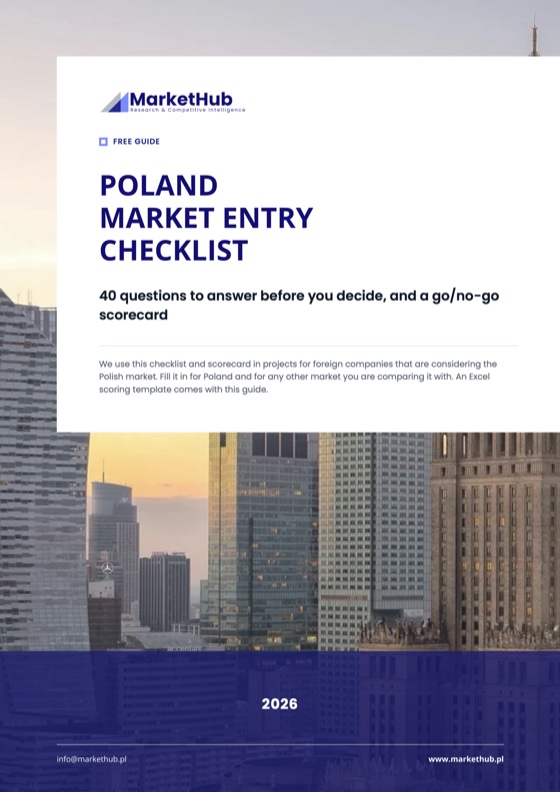
PDFCover of the MarketHub Poland market entry checklist
Free download · PDF + XLSX

Get the Poland market entry checklist and the go/no-go scorecard

40 questions worth answering before you decide to enter Poland, a go/no-go scorecard and an Excel template to compare markets against weighted criteria.

  • PDF: 40-question checklist and go/no-go scorecard
  • XLSX: market scoring template

Enter your work e-mail and company name. We will send links to both files straight to your inbox.

How much does it cost to enter Poland?

That depends on your product and entry mode, so we calculate it for your case. You get the cost model in an XLSX file. The assumptions are explicit, so you can change them and see the result at once.

Hands at a calculator next to printed cost charts
Step 1

One-off costs

Registration, certification and product testing, translation and labels, sales materials, trade fairs, first stock.

Step 2

Running costs

People, office or representative, warehouse and logistics, marketing, legal and accounting services.

Step 3

Break-even

At what sales level and after how long entry starts to pay off.

Step 4

Three scenarios

Cautious, base and optimistic: how the result changes when sales are lower or higher than planned.

Step 5

EUR and PLN

We give amounts in EUR and PLN and show how the exchange rate affects costs, prices and break-even.

What does the report contain?

Examples of what the report covers. We agree the scope in the quote and at the first workshop.

A recommendation on 1–2 pages: whether to enter, where, in what form and with whom
A market ranking against the criteria and weights agreed with your board
Market profiles: size, growth, segments, prices and distribution channels
The largest local players and importers, with their offers and prices
Regulation and certification: what you must comply with, how long it takes and what it costs
A cost model with break-even in three scenarios
An entry plan with timeline, budget and progress indicators

Management workshops

We build the strategy together with your board, online or on site. That way the recommendation rests on criteria the board set itself.

At the start

Workshop 1: decision criteria

At the start we agree how large a market has to be, how much you can spend on entry and how soon the investment should pay back. You leave with a list of markets to compare and the criteria weights.

At the end

Workshop 2: recommendation

At the end we discuss the results: market ranking, entry mode, cost model and the plan of first steps. You leave with a decision and a task list.

Participants

Who should attend

The person who makes the decision and those responsible for sales or exports, finance and product. The fewer people you have to convince later, the better.

What you get

Every report is different, because we set the scope around your decision and your markets. The elements below are examples.

Comparison of 2–5 target markets
Demand, competition, prices and distribution channels
Legal requirements, certification and barriers
Entry cost model with three scenarios
Recommendation: whether to enter, how and with whom, plus a workshop with your board

In what form:

Report in English (PDF) with the recommendation and entry plan
Cost model in XLSX with three scenarios
Comments from industry, scientific and business experts
Two workshops with your board, online or on site

How long does the strategy take?

A market entry strategy usually takes 4–8 weeks from accepting the quote. Timings are indicative. You get the exact schedule in the quote.

  1. Before the start · free of charge
    Step 1 · week 0

    A call, then scope, timeline and price within 72 h

    From you: a description of the decision, the markets and your deadline

  2. From accepting the quote: usually 4–8 weeks
    Step 2 · week 1

    Workshop 1: decision criteria and list of markets

    From you: your board’s time, product and price data

  3. Step 3 · weeks 2–5

    Analysis of markets, competitors and regulation

    From you: answers to our analysts’ questions, if any

  4. Step 4 · weeks 4–7

    Cost model, scenarios and market ranking

    From you: a short call on preliminary results

  5. Step 5 · weeks 6–8

    Recommendation and workshop 2 with your board

    From you: workshop date and list of participants

More markets, interviews in target markets and workshop dates extend the timeline.

What this does not cover

The strategy tells you whether and how to enter. These steps need other advisers:

Legal advice

Contracts, choice of legal form and regulatory opinions need a law firm.

Tax advice

VAT registration, customs and corporate tax questions need a tax adviser.

Company registration

You set up a Polish company or branch with a law firm or an accounting firm.

Recruitment

Hiring a local team needs a recruitment agency.

Our report lists the questions you should bring to these advisers.

Case studies

Production hall
Market entry strategy · 7 weeks

Three footwear manufacturers: Turkey

Three separate reports for producers of leather, orthopaedic and casual shoes: the market, the ten largest local manufacturers, standards and the recommended entry through a local distributor or representative. The same method works for Poland.

Read the case study

Steel frame of an industrial hall under construction
In-depth market analysis

Steel structures producer

Demand forecast for steel structures in Poland to 2035 in three scenarios: energy, bridges, rail and industrial construction.

Read the case study

We have worked on Poland, Turkey, the USA and the DACH countries. See more in our case studies.

Who will prepare your strategy

Our analysts prepare the research. You have one contact person throughout the project.

Patrycja Hrabiec-Hojda

Patrycja Hrabiec-Hojda

Managing Partner · market analyst · OSINT trainer

Founded Infobrokerska in 2006, one of the first information brokerage firms in Poland, which grew into MarketHub. Has led analytical projects for 20 years and runs training in open-source intelligence (OSINT). Co-authored the professional standards for information brokers for the Polish Ministry of Labour.

dr Łukasz Brzeziński, MarketHub

Dr Łukasz Brzeziński

Expert · market analyst

PhD in economics. Prepares advanced market reports and analyses. Assesses market potential, writes business plans and values technologies, patents and know-how.

Katarzyna Kucia, MarketHub

Katarzyna Kucia

Expert · analyst · information broker

Prepares market analyses and reports, develops analytical materials and carries out desk research, including in scientific sources. Writes MarketHub market reviews and articles for the Rynek Informacji portal.

Meet the whole team

Too much? Not enough?

Are you an adviser, law firm or agency that wants to offer clients analyses under its own brand? See our offer for advisers.

Questions about entering the Polish market

About the service

What is a market entry strategy?

A project that ends with a recommendation: whether to enter Poland, in what form and with whom. We compare up to five markets against criteria agreed with your board, calculate entry costs in three scenarios and discuss the results at two workshops. It usually takes 4–8 weeks.

What is the expert commentary in your reports?

Opinions from industry, scientific and business experts we choose for the topic of the project. The expert explains what is behind the figures, checks the estimates and conclusions, and says what they may mean for your decision. The commentary is part of every paid MarketHub report.

Do we get a clear go or no-go?

Yes. At the end we state plainly whether to enter, how and with whom, and we discuss it with your board at the second workshop. If the answer is no, we explain why and what would have to change.

How is it different from a market analysis?

A market analysis describes one market for your decision. An entry strategy compares markets, chooses the entry mode and partners, calculates costs and ends with an action plan. If you have already chosen Poland, an in-depth market analysis is usually enough.

Can you compare Poland with other markets?

Yes. Poland, the EU, DACH, Scandinavia, Turkey and the USA. For more than five markets we propose a short screening first and a full analysis of the best two or three.

Entering Poland

What are the main ways to enter the Polish market?

Direct export, a distributor, a sales agent, a branch, a Polish company, an acquisition, a joint venture or e-commerce, including marketplaces such as Allegro. The table above compares their cost, control, risk and time.

Do we need a Polish company to sell in Poland?

Not necessarily. Many foreign companies sell to Polish customers from abroad or through a distributor. Whether you need a Polish VAT registration, a branch or a company depends on how you sell, for example whether you keep stock in Poland. Check this with a tax adviser.

How important is Polish-language marketing?

Very. Many B2B buyers in Poland speak English, but offers, websites, catalogues and documentation in Polish make selling easier. For consumer products, the Polish Language Act requires product information and instructions in Polish.

What certifications might we need?

EU rules such as CE marking apply in Poland as in other EU countries. Some products also need Polish registrations or national approvals, for example food supplements notified to the Chief Sanitary Inspectorate or construction products covered by national rules. We list what applies to your product in the report.

How long does it take to start selling in Poland?

It depends on the entry mode and certification. Through a distributor or e-commerce it is usually faster than through your own company, which needs registration, hiring and set-up. The entry plan in the report gives a timeline for your case.

Method

How do you calculate entry costs?

In an XLSX model: one-off costs (certification, translation, trade fairs, first stock), running costs (people, logistics, marketing) and break-even, in three sales scenarios, in EUR and PLN.

Who should attend the workshops?

The person who makes the decision and those responsible for sales or exports, finance and product.

Do you talk to potential partners in Poland?

Yes, if the scope includes it. Our analysts interview distributors, importers and industry experts in Polish. We agree the number of interviews in the quote.

Time and price

How long does it take?

Usually 4–8 weeks from accepting the quote, depending on the number of markets, interviews and workshop dates.

What does the price depend on?

On the number of markets and interviews, whether the markets are in the EU or outside it, and the deadline. We send the quote with scope and timeline within 72 hours.

After the project

What happens after the recommendation?

At the second workshop we turn the recommendation into a plan: steps, timeline, budget and indicators. Later we can track competitors in Poland as part of competitor monitoring.

Can you help find a distributor?

Yes. After the strategy we can build a distributor shortlist: 15–25 potential partners checked in Polish registers and called in Polish.

Request a quote for a market entry strategy

Quote form

Request a quote: Market entry strategy

We send the scope, timeline and price within 72 hours of your enquiry.

Related: In-depth market analysis · Distributor shortlist · Market reviews · Case studies

Scroll to Top
CallQuote in 72 h