

Organic fertiliser market analysis
Our analysis of the fertiliser market shows that the shift towards natural fertilisers is closely linked to the idea of green productivity in agriculture. Using these fertilisers helps to minimise environmental pollution. It also promotes the reuse and recycling of organic farm waste and crop residues. On top of that, it improves biodiversity and soil productivity. As a result, it helps to improve living conditions in rural areas and supports sustainable development, creating new jobs and raising farm incomes.
The full report on this market in PDF, delivered in 3 business days.
Order the scan01
The global fertiliser market
The organic and eco-friendly fertiliser market is going through a rapid transformation. Products of natural origin, in line with sustainable agriculture and soil regeneration, are becoming more and more important. Demand for organic farm produce is growing worldwide, which translates directly into interest in fertilisers that are safe for the environment and human health. This segment is becoming one of the key components of the green transformation of agriculture, both in the European Union and in developing countries, where soil and groundwater pollution is turning into a structural problem.
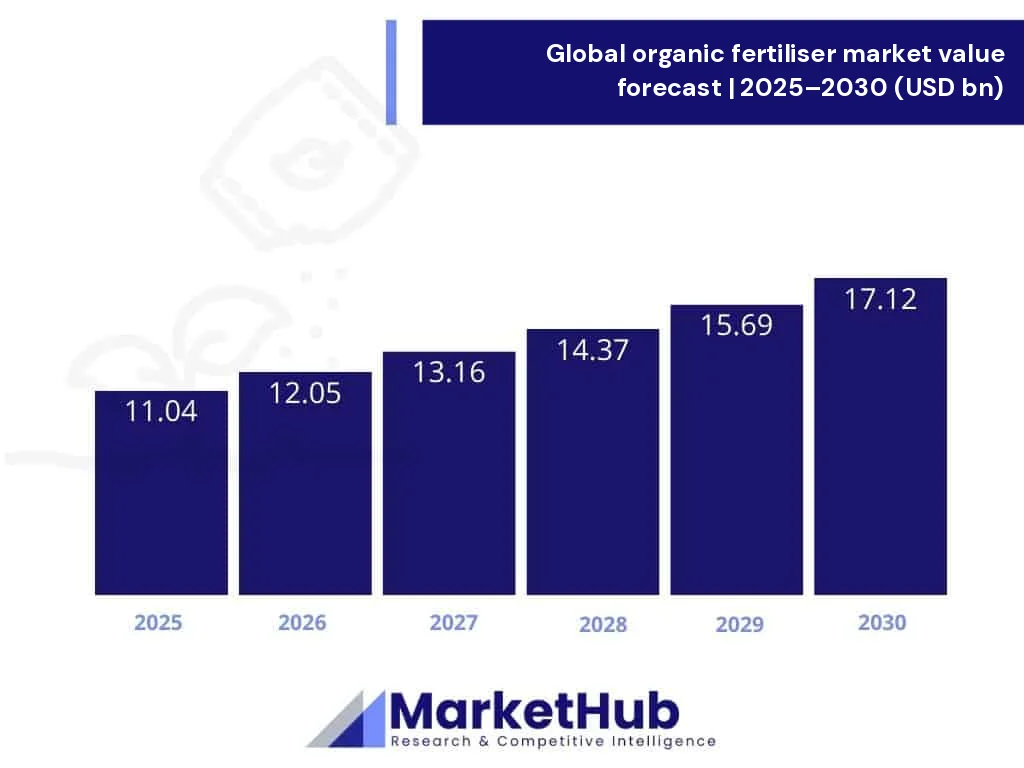
The organic fertiliser market is growing fast. Its size is estimated at USD 11.04 bn in 2025. Forecasts say it will reach more than USD 17 bn by 2030, growing at a CAGR of about 9.17% a year. Growth is driven by:
Global trends in the use of organic fertilisers
In highly industrialised countries with advanced agriculture, such as the United States, Japan and the United Kingdom, organic fertilisers already account for about 50% of total fertiliser use. This is, of course, far above the level of natural fertiliser use in Poland, where mineral fertilisers still dominate. Consumption of organic fertilisers is concentrated in regions with a high level of economic development and a large share of industrial farming. Western Europe remains the leader with about 31.8% of global use, followed closely by North America (29.9%) and Asia-Pacific (21.7%). This shows that the growth of the organic fertiliser market goes hand in hand with pro-environmental policies, the technological level of agriculture and growing demand for high-quality food.
02
Organic fertiliser market segmentation
The organic fertiliser market can be divided into:
03
The fertiliser market in Poland
Our analysis of the fertiliser market in Poland shows that nitrogen fertilisers dominate, with nitro-chalk, urea and ammonium nitrate being the most important. Poland accounts for 1.2% of global fertiliser production (1.5% for nitrogen fertilisers) and 18% of EU fertiliser production (20.3% for nitrogen fertilisers).
Natural fertilisers play a key role in organic farming, which is becoming more important in Poland. Using organic fertilisers is in line with sustainable development and helps to improve soil quality and protect the environment. Poland is a net importer of natural fertilisers. In 2023 Poland accounted for 0.4% of global natural fertiliser exports and 2.8% of imports. This means that domestic demand for natural fertilisers exceeds domestic production, so they have to be imported.
Challenges and outlook for the organic fertiliser market in Poland
Despite growing interest in natural fertilisers, their use faces some barriers, such as:
04
Trends in the organic fertiliser market
In recent years the organic fertiliser market has been at the centre of major changes, driven by shifting social expectations, policy decisions and technological progress. What matters more and more is not only how effective fertilisation is, but also its impact on the environment, human health and long-term soil quality. As a result, interest in natural and sustainable solutions is growing, and organic fertilisers, both traditional and innovative, are gaining popularity. Below are the key trends that are shaping the market and setting the direction of its development.
Want to understand the fertiliser market in Poland and Europe better? Get the full report Fertiliser Market in Poland. Analysis, Prices, Risks, Trends and Development, which provides detailed data, forecasts and practical recommendations.
What is the outlook for the organic fertiliser market in Poland?
A ready-made PDF report from Market Scan by MarketHub: market size, key players, trends and data sources. We email it to you within 3 business days after payment.
Want to use this brief?
You can quote the data if you name the source and, where possible, link to our website. Use this credit line:
Source: MarketHub, "Organic fertiliser market analysis", markethub.pl, 04.2025