

Coal market analysis
Our coal market analysis shows how the directions of coal imports and exports have changed. The brief describes the most important factors affecting the global coal market today. It also presents forecasts for the future and the current leaders in coal mining.
Need ready-made market data? See the reports in Market Scan.
See the scan catalogueOur analysis showed that coal imports have fallen both in Poland and in Europe. At the same time, stocks held in the ARA ports (Amsterdam-Rotterdam-Antwerp) have increased. Prices rose sharply in March 2022 (USD 451.2/t on 07.03.2022) after Russia's attack on Ukraine, and have begun to return to pre-invasion levels (USD 62.65/t on 08.03.2021). Taking into account the general rise in prices, it can be said that prices have even fallen below this level (USD 123.65/t on 08.03.2023). As of 05.10.2023, the price of coal in ARA is USD 120.05, while in RB (Richards Bay) it is USD 121.50.
01
Where does Poland import coal from?
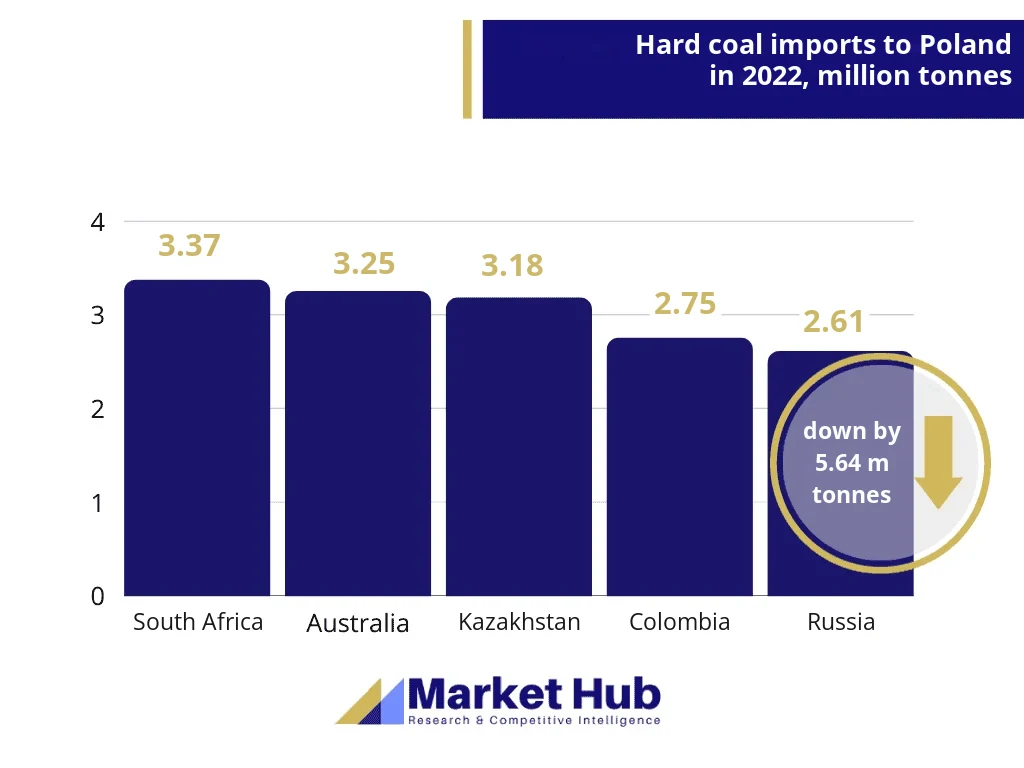
In 2022 the leading suppliers of coal to Poland were South Africa (3.37 m tonnes), Australia (3.25 m tonnes), Kazakhstan (3.18 m tonnes) and Colombia (2.75 m tonnes).
In 2021 the main countries exporting hard coal to Poland were Russia (8.25 m tonnes), Australia (2.01 m tonnes), Colombia (0.61 m tonnes), Kazakhstan, the Czech Republic, the USA, Mozambique and Canada. This changed after the outbreak of the war in Ukraine. The sanctions imposed on Russia and the efforts of EU countries to become independent of Russian gas and coal made Poland's coal imports more evenly spread across suppliers in 2022. The leading suppliers to Poland became South Africa (3.37 m tonnes), Australia (3.25 m tonnes), Kazakhstan (3.18 m tonnes), Colombia (2.75 m tonnes), Russia (2.61 m tonnes, a sharp drop) and Indonesia (1.75 m tonnes). In the global coal market, imports of this commodity fell in the European Union, the United Kingdom and Japan. This is linked to the drive for decarbonisation in line with the Paris Agreement. The opposite happened in India. Despite its efforts to reduce CO2 emissions, it was forced to increase imports by the current climate situation described later in the article.
02
What trends are shaping the coal market in Poland and worldwide?
Hard coal production in Poland is falling: in June 2023 it was 3,852,504 t, compared with 4,391,822 t a year earlier, while stocks rose to 3,268,237 t.
A study of the coal market in Poland showed that compared with June 2022, hard coal production in the same period of 2023 fell from 4,391,822 t to 3,852,504 t, a difference of −539,317 tonnes. At the same time, closing stocks of hard coal were lower last year than in the same period this year. In June 2022 they amounted to 1,466,630 t, while a year later they were 3,268,237 t, a difference of 1,801,607 t. This coincides with the increase in stocks in ARA. In line with the Paris Agreement, countries are looking for alternative energy sources to reduce CO2 emissions and become independent of coal. One example is Japan, which is limiting coal imports in favour of nuclear energy. Indonesia has adopted a different strategy, aiming to cut CO2 emissions to zero by 2060. To achieve this, it is diversifying its energy sources, investing, among other things, in geothermal energy.
03
What threats are affecting the coal market?
The European coal market was affected by high gas prices in September, while in India El Niño brought record low rainfall and higher demand for energy.
The European coal market was affected by high gas prices in September. These resulted from a strike by workers at Chevron Co and from maintenance and repair work on Norway's gas infrastructure, including the suspension of natural gas production from the Troll field. On the other side of the world, this year's El Niño phenomenon, which occurs every 2–7 years, had an impact. It contributed to record low rainfall in India during the monsoon season. As a result, imports of and demand for energy increased, and the Indian government took steps to increase and secure coal supplies and production.
04
What is the outlook for the coal market to 2030?
In the baseline scenario, coal exports from Russia will fall slightly to 219 m tonnes by 2030, with India becoming the leading buyer with a 40% share.
Analysts note that in the baseline scenario coal exports from Russia will not experience major shocks. By 2030 they will fall slightly, to 219 m tonnes. The mix of buyers, however, will change. In 2030 the leader will be India, with a 40% share of Russian exports. The countries of South-East Asia will account for 20–25%, and Turkey and European countries outside the EU for about 20%. Africa and the Middle East will account for 15% of exports. China, which is relying heavily on its own sources, will reduce its share to 5%. According to sources quoted by Reuters in May 2023, India is withdrawing from building new coal-fired power plants. In the long term, it plans to implement a decarbonisation process. Indonesia, Colombia and Panama have also taken steps towards phasing out coal by 2030.
Author: Monika Marszałek
Sources:
Ready-made market reports in PDF
Market Scan by MarketHub has ready-made PDF reports on selected markets: market size, key players, trends and data sources. If your market is not covered, we will prepare an in-depth market analysis.
Want to use this brief?
You can quote the data if you name the source and, where possible, link to our website. Use this credit line:
Source: MarketHub, "Coal market analysis", markethub.pl, 10.2023