

Renewable energy and green economy market analysis
Exploitation of the environment leads to irreversible changes and has become a global challenge. Responses include a variety of sustainable development strategies that balance progress with the protection of resources. Initiatives, including international cooperation, regulation and financial support, aim to encourage environmentally friendly attitudes and develop green infrastructure. This analysis of the ecology and renewable energy market outlines the current conditions and trends in this area in Poland and other European countries.
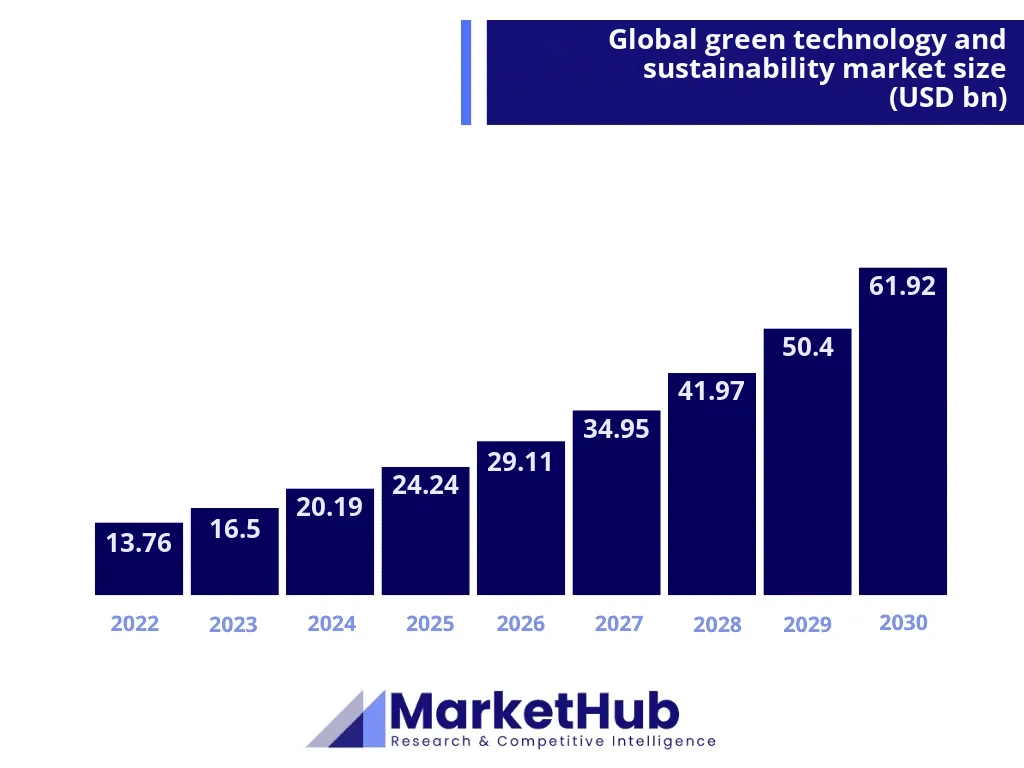
The global green technology and sustainability market is forecast to keep growing until 2030. In 2022 it was worth around USD 13.76 bn, and it is expected to reach almost USD 62 bn by 2030, growing by 20.8% a year in 2023–2030.
Where is organic food sold in Poland?
According to the 2021 report Żywność ekologiczna w Polsce, every Polish town with more than 20,000 inhabitants has an organic food shop, and supermarket chains and the internet are also important channels.
The performance of the organic food market depends not only on the number of producers but also on other players, such as processing plants and sales channels. Data from the 2021 report Żywność ekologiczna w Polsce (Organic food in Poland) show that every Polish town with more than 20,000 inhabitants has an organic food shop. In addition, more and more hypermarket and supermarket chains are adding sections for organic food. The internet is another important sales channel. Sellers range from online-only specialist shops and brick-and-mortar outlets looking to expand, to smaller sellers on marketplaces such as Allegro.pl. Because online sellers of organic food are so fragmented, it is hard to estimate their exact number. Equally important here is the growing popularity of meal-box diet services, whose menus increasingly feature organic products.
How does Poland's organic products market compare with Europe?
Poland has 507,000 ha of land under organic certification, or 3.5% of agricultural land, while the leaders France, Spain and Italy each have over 2 million ha of organic crops.
In 2021, Italy, Spain and Turkey had the most organic food producers in Europe, each with several times more than Poland. By organic farming area, the leaders are France, Spain and Italy, each with over 2 million ha of organic crops. Poland currently has 507,000 ha of land under organic certification. This represents 3.5% of agricultural land.
A general analysis of the European organic market showed that organic production is increasing in the European Union, both in the number of farms and in the total area under organic cultivation. Most countries showed steady growth in both indicators over the period analysed.
How big is the renewable energy market in Poland?
The renewable energy market in Poland is estimated at 25.08 GW in 2024 and is expected to reach 49.38 GW by 2029.
An important part of sensible resource management is how much energy is obtained and, above all, how. The renewable energy market in Poland is estimated at 25.08 GW in 2024. It is expected to reach 49.38 GW by 2029, at a CAGR of 14.51% over the forecast period (2024–2029). In 2018–2022, primary energy consumption in Poland fell by 3.3%. At the same time, consumption of energy from renewable sources (RES) increased by 10.1%. The share of RES in total energy consumption in 2022 was 12.8%, an increase of 1.6 pp compared with 2018. Poland ranks well below the EU average, which was 22% in 2020 and 21.8% in 2021.
An analysis of the current state of RES in Poland shows that solid biofuels are the most important. These are organic substances such as wood and wood-derived waste as well as waste from agricultural and horticultural production. Their share of consumption fell compared with 2021. Wind energy and liquid biofuels have the next largest shares of energy consumption. Solar energy recorded the largest increase compared with 2021 (2.8 pp), mainly because of the rapid growth of photovoltaics.
What is the outlook for the ecology and RES market in Poland?
The organic products and RES markets in Europe and Poland are growing despite rising inflation and the unfavourable situation caused by the war in Ukraine. Despite similar growth trends in Poland and Europe, Poland still does not hold a strong position in the international ecology market. However, growing public awareness of the state of the environment, driven partly by social campaigns and the non-profit sector, may lead to further and more effective action in this field. In mid-January, Members of the European Parliament adopted a new directive that will revolutionise the organic products sector. The new rules aim to make the product labelling system simpler and more credible. Under the new rules, it will no longer be possible to use unverified generic environmental claims such as "eco-friendly", "natural", "biodegradable", "climate neutral" or "ecological" without specific justification. Once the Council of the European Union approves the directive, member states will have 24 months from its publication in the Official Journal of the European Union to implement the new rules.
Authors: Katarzyna Saracen, Katarzyna Kucia
This text is not a full market analysis of the kind we carry out for our clients. It contains only selected information about the market, which we can expand on request.
Ready-made market reports in PDF
Market Scan by MarketHub has ready-made PDF reports on selected markets: market size, key players, trends and data sources. If your market is not covered, we will prepare an in-depth market analysis.