

Plant-based products market analysis
The global food system is currently undergoing one of the most fundamental changes in its history, driven by a mix of health, environmental and technological factors. Vegan and vegetarian products are no longer seen as a niche: they have become part of the mainstream food market.
Need ready-made market data? See the reports in Market Scan.
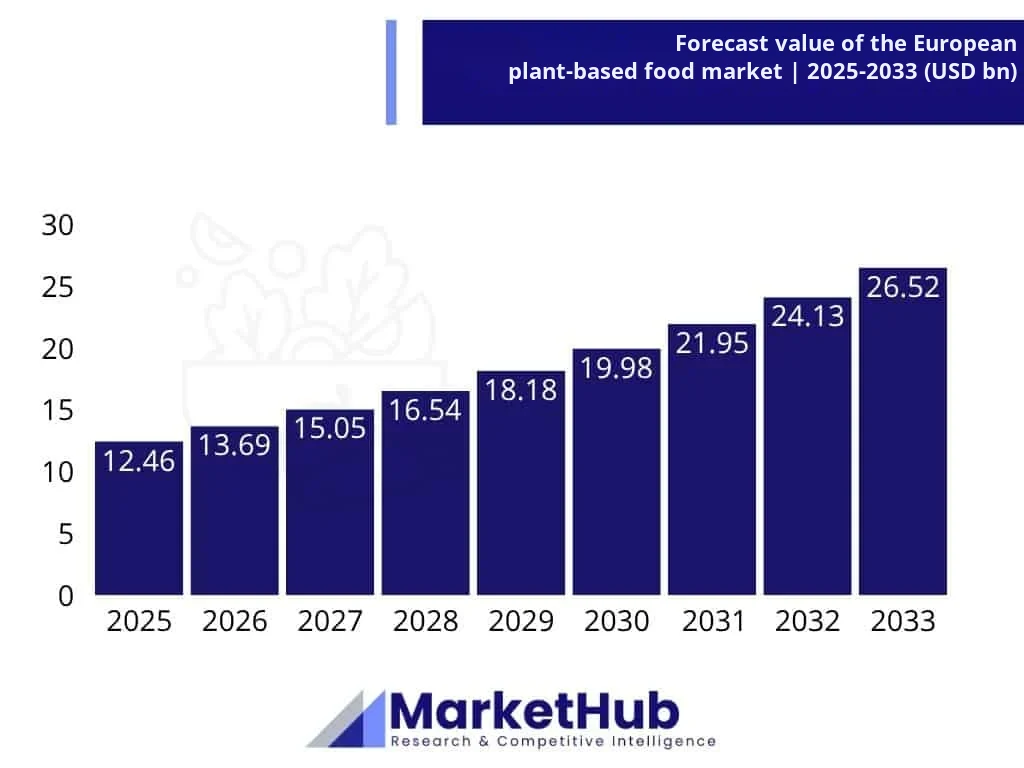
See the scan catalogueThe European plant-based food market is currently stabilising after a period of rapid expansion, which is typical of sectors entering maturity. The value of this market in 2024 was estimated at USD 11.34 bn. Forecasts indicate steady growth, with the market reaching USD 12.46 bn in 2025 and, in the long term, USD 26.52 bn by 2033. A compound annual growth rate (CAGR) of 9.9% in 2026–2033 reflects lasting changes in consumer habits, which temporary economic turbulence has not halted.
Dairy alternatives dominate the European market, with 67.2% of the total sales value of plant-based products in 2024. The second most important segment is meat alternatives. Although they face challenges with texture and degree of processing, they are still an important part of the modern consumer's shopping basket. The European plant protein market as a whole is set to grow from USD 4.34 bn in 2025 to USD 5.85 bn in 2030, indicating growing demand for high-quality raw materials for the processing industry.
01
How big is the plant-based products market in Poland?
The Polish plant-based products market reached PLN 1.08 bn in 2024, compared with around PLN 441 m in 2020.
The plant-based products market in Poland is currently catching up rapidly with the mature markets of Western Europe. The value of the Polish plant-based products market in 2024 exceeded the PLN 1 bn mark, reaching PLN 1.08 bn. This is very rapid growth, considering that as recently as 2020 the value was around PLN 441 m, and in 2022 it exceeded PLN 600 m.
The Polish market stands out above all for the dominance of plant-based dairy. From January to August 2025, Polish households spent PLN 472 m on plant-based meat and dairy alternatives. As much as 85% of this went on plant-based alternatives to milk, yoghurts and cheeses, which reached 41% of households in the country during that period. The Polish plant-based food sector also shows a high rate of new product launches. Almost one in ten new food products in Poland in 2023 was classified as vegan, which puts the country among the leaders in product innovation in this region of Europe.
Despite such rapid growth in the alternative segments, the traditional meat market in Poland remains extremely strong. In 2025, 99.6% of households still bought meat products, spending a total of nearly PLN 38 bn on them over eight months. This suggests that the growth of the plant-based market in Poland is happening mainly through a flexitarian approach: consumers do not give up meat completely, but include plant-based products in their diet for variety or as a healthier alternative.
02
How are consumers in the plant-based products market changing?
Flexitarianism is moving into the mainstream: in Poland one in five consumers chooses plant-based alternatives to animal products, and 27% of Poles said they had increased their consumption of plant-based products in the last year.
The most important trend shaping the market in 2025 and 2026 is flexitarianism's final move into the mainstream. In Germany, 42 million people already say they cut out meat at least three days a week, which is almost half the population. In Poland, one in five consumers chooses plant-based alternatives to animal products, and 27% of Poles said they had increased their consumption of plant-based products in the last year.
Motivations for choosing a plant-based diet have shifted from purely ethical to pragmatic and health-related ones. For 34% of Poles the main reason for buying meat alternatives is health, and for another 34% it is taste. Environmental issues, although important in marketing communication, are the deciding factor for around 21% of respondents. This more pragmatic attitude means that plant-based products must compete with traditional ones not only through an ethical message, but above all on taste, price and nutritional profile.
Trust, quality and consumer patriotism
In Poland, certification and product origin are becoming key to building market advantage. In 2025 as many as 84.2% of Poles say that, given the choice, they prefer to buy products of Polish origin. This phenomenon, described as "practical economic patriotism", goes hand in hand with growing quality requirements. Consumers are less and less willing to pay "for a promise"; they expect concrete proof of quality, such as the "Teraz Polska" mark (recognised by 72.1% of respondents) or organic certificates.
For plant-based food producers, this means they need to localise production and make their supply chains transparent. Brand trust is built through emotions such as pride in Polish products (35% of responses) and a sense of security when choosing trusted brands (24.4%). In 2025, 73.7% of Poles say they are willing to pay more for a high-quality product, but this is lower than in 2024 (82.9%), which points to growing price sensitivity caused by inflation.
03
What innovations are changing the plant-based products market?
In 2026 the market is moving away from highly processed meat imitations towards products with simple ingredients (clean label), and precision fermentation is becoming the industry's "unsung hero".
In 2026 the plant-based food market is entering a "Reset" phase: a move away from highly processed meat imitations towards products with simple ingredients (clean label) made with advanced biological processes. The debate on ultra-processed foods (UPF) shook the market in 2024 and led to a kind of "crash" in trust in vegan products with complicated ingredient lists. In 2026 a short ingredient list and the use of whole plants are becoming the standard. Products based on mushrooms, pulses and root vegetables are gaining an advantage over isolated soy proteins. Precision fermentation is becoming the industry's "unsung hero". It can produce proteins identical to animal ones (e.g. casein or egg protein) without using animals. This makes it possible to create plant-based cheeses that melt and taste like traditional ones, which until now has been the biggest barrier for the vegan dairy segment. In the coming years this technology is expected to move from niche applications into the mainstream.
04
What is holding back the plant-based products market?
The biggest barrier is the lack of price parity: in 2024 and 2025 plant-based products were regularly two to four times more expensive than their conventional equivalents.
The biggest obstacle to mass adoption of a plant-based diet remains the lack of price parity with traditional products. In 2024 and 2025 plant-based products were regularly two to four times more expensive than their conventional equivalents. High inflation hit the vegan sector harder than the meat sector: average prices of meat alternatives rose by 13% over two years, while prices of traditional meat rose by only 4%. For 28% of consumers who reduced their consumption of plant-based products in 2024, the main reason was that these products no longer fitted their household budgets. In Poland, although 73.7% of respondents say they are willing to pay extra for quality, price largely determines what people actually buy.
How private labels make prices more affordable
In the face of inflationary pressure, retailers' own brands (private labels) are becoming a major driver of growth. In Germany, private label sales volume grew by 8.9% in 2024, while manufacturer brands stagnated. In Poland, chains such as Biedronka and Lidl account for nearly 40% of sales in the meat and plant-based categories, offering vegan products at prices close to traditional ones. More than half of the new plant-based products launched in the Polish market in recent years were private labels, which suggests that they will be the key to achieving mass scale in the future.
05
What EU regulations apply to plant-based products?
Producers are affected by the March 2026 EU agreement banning 31 meat-related names, the PPWR packaging regulation adopted in 2025 and the EUDR deforestation regulation.
Plant-based food producers have to operate in an increasingly complex legal environment which, on the one hand, promotes sustainable development and, on the other, introduces restrictions that protect traditional farming sectors.
Naming and labelling
In March 2026, EU bodies reached an agreement on restricting the names of plant-based products associated with meat. The use of 31 terms has been banned, including names of species (e.g. "chicken", "beef") and specific cuts of meat (e.g. "steak", "breast"). At the same time, the right to use format terms such as "burger", "sausage" and "nuggets" has been retained as a compromise that lets consumers identify products. Producers have three years to adapt their packaging and communication strategies.
New environmental and packaging requirements
The PPWR (Packaging and Packaging Waste Regulation), adopted in 2025, imposes strict requirements on recycling and reducing plastic. From August 2026, bans on single-use plastic packaging for small portions of fruit and vegetables will apply, together with restrictions on PFAS substances in food-contact packaging. In addition, the EUDR (European Union Deforestation Regulation) will require producers to prove that raw materials such as soy do not come from land deforested after 2020, For smaller companies, this means full supply chain transparency from June 2026.
Ready-made market reports in PDF
Market Scan by MarketHub has ready-made PDF reports on selected markets: market size, key players, trends and data sources. If your market is not covered, we will prepare an in-depth market analysis.
Want to use this brief?
You can quote the data if you name the source and, where possible, link to our website. Use this credit line:
Source: MarketHub, "Plant-based products market analysis", markethub.pl, 04.2026