

Aesthetic medicine services market in Poland
The beauty industry, and the aesthetic medicine market in particular, is growing rapidly in Poland, responding to the social and aesthetic needs of a growing number of consumers. Demographic change, technological progress and the influence of social media are making aesthetic treatments accessible, popular and socially accepted.
Need ready-made market data? See the reports in Market Scan.
See the scan catalogue01
How big is the aesthetic medicine market in Poland and worldwide?
In 2024 the global aesthetic medicine market was valued at USD 88.92 bn, while the aesthetic injectables market in Poland was worth USD 17.63 m.
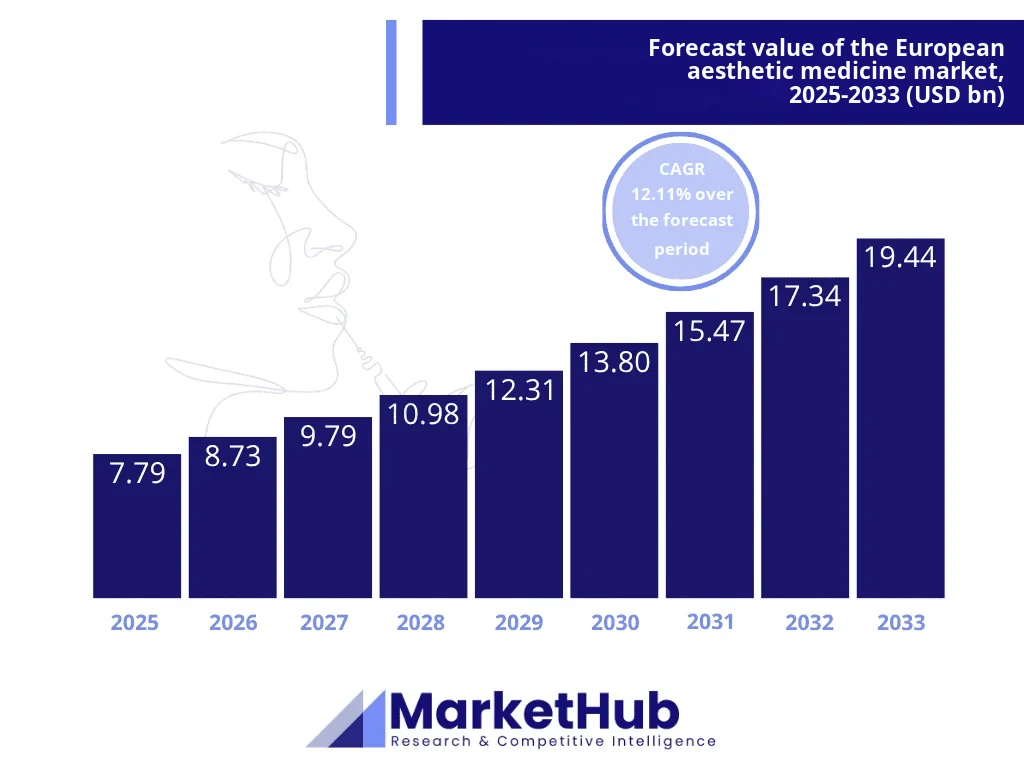
In 2024 the global aesthetic medicine market was valued at USD 88.92 bn and is expected to grow at a compound annual growth rate (CAGR) of 8.3% over 2024–2030. The European aesthetic medicine market, in turn, was worth USD 6.95 bn in 2024. Forecasts suggest that the market will reach USD 7.79 bn in 2025 and USD 19.44 bn by 2033, with an expected CAGR of 12.11%.
The aesthetic injectables market in Poland was worth USD 17.63 m in 2024 and is expected to reach USD 40.53 m by 2033, growing at a CAGR of 9.69% over the 2025–2033 forecast period. The cosmetics market in Poland
An analysis of the aesthetic medicine market cannot ignore the cosmetics market. The Polish cosmetics market was worth more than PLN 25 bn in 2023, and forecasts suggest it will pass PLN 30 bn by 2028. According to the Polish Investment and Trade Agency (PAIH), it should grow by a further PLN 0.8 bn a year. In 2024, 14,700 new companies were set up in this sector, which shows how fast the beauty industry is growing. Poland is also one of the leading countries in Central and Eastern Europe by number of treatments performed and number of aesthetic medicine clinics. By share of cosmetics exports, Poland ranks fifth in the EU (8%) and ninth in the world (3.8%). Of these exports, 65% go to the European Union and the remaining 35% outside it. As Ewa Przybyś, owner of Source of Beauty, founder of SuperKreatywne, strategic business adviser and creative mentor to brands such as Skin Light Esthetical and Tesla Med, points out:
The cosmetology and aesthetic medicine market is undergoing a deep transformation, driven by growing consumer awareness and evolving aesthetic preferences. We are seeing a clear shift towards solutions based on natural regenerative mechanisms, focused on rebuilding the skin at cellular level rather than superficially camouflaging its flaws.
02
Who uses aesthetic medicine services?
Aesthetic medicine is used by patients of all ages, from under-20s to people over 70, and those aged 40–54 make up the largest group of plastic surgery patients.
Social media now strongly influence many aspects of everyday life, and aesthetic medicine is no exception. Platforms such as Instagram, TikTok and Facebook have become places where people show changes in their appearance and share their experiences of treatments and opinions on the results. For younger generations, and especially Generation Z, using aesthetic medicine is increasingly a natural part of caring for their appearance and self-presentation.
Women are increasingly choosing non-invasive therapeutic procedures, such as manual therapy and cosmetic acupuncture, as an integral part of preventive skin care. The growing interest in holistic methods that activate the body's own repair processes is a response to fatigue with aggressive technologies and to the need for a long-lasting aesthetic effect, adds Ewa Przybyś.
Generation Z (under 30)
The youngest patients, under 20, both women and men, most often opt for ear and nose corrections and breast reduction. Procedures improving the appearance of the skin, such as laser hair removal, are also popular in this group. For the slightly older part of Gen Z (aged 20–29), raised in a culture of influencers and selfies, breasts and face are the priority. Breast augmentation and rhinoplasty dominate, and among men, gynaecomastia surgery. Non-surgical laser treatments intended to improve skin condition and prevent signs of ageing are also playing a growing role.
Millennials (30–39)
Millennials entering middle age still focus on the appearance of the face and bust, and breast augmentation remains one of the most frequently chosen procedures. Body contouring procedures such as liposuction and abdominoplasty are also gaining popularity. In the non-invasive segment, skin treatments, resurfacing, lasers and sclerotherapy dominate.
Older Millennials and Generation X (40–54)
Although often called the "forgotten generation", they make up the largest group of plastic surgery patients. They focus mainly on the lower body: abdominoplasty and thigh, buttock and lower body lifts. At the same time, they are the most frequent users of neuromodulator injections (e.g. Botox®) and hyaluronic acid fillers, trying to slow down the effects of ageing and keep a youthful appearance.
Baby Boomers (55+)
For older patients, the face remains the main area of interest. Face, neck and brow lifts are still the most frequently performed procedures in this age group. Eyelid surgery and treatments improving skin texture are also popular. Even people over 70 are increasingly opting for facial rejuvenation procedures.
03
How much do Poles spend on aesthetic medicine treatments?
Spending on aesthetic medicine in Poland varies widely by region: in 2024 clients in Lublin spent an average of PLN 634 on treatments, while in Elbląg only PLN 119.
Average monthly spending on general cosmetic treatments and services in Poland ranges from PLN 100 to PLN 500. In aesthetic medicine, however, spending is much higher and shows significant regional differences. For example, clients in Lublin spent an average of PLN 634 in 2024 on aesthetic medicine treatments, while in Elbląg only PLN 119. Such large differences between cities point to a fragmented market. Poland's regions differ in market maturity, disposable income and cultural acceptance of these services. As a result, market entry or expansion strategies cannot be uniform. They must be highly localised, based on a detailed analysis of the regional market, with services and pricing models adapted to local conditions.
04
What are the key trends in aesthetic medicine in 2025?
In 2025 aesthetic medicine focuses on skin regeneration and natural-looking results. Polynucleotides and tissue biostimulators, which support repair and improve skin firmness and hydration, are playing an increasingly important role. Biomimetic peptides and modern retinoids (e.g. retinaldehyde) effectively reduce wrinkles without irritation.
Proprietary combined therapies are growing in popularity. These synergistic procedures, based on advanced biomolecular preparations and next-generation medical technology, can deliver a broad spectrum of results in a single treatment session, notes the owner of SuperKreatywne.
Nanotechnology allows active ingredients to work more deeply, and plant extracts and adaptogens such as bakuchiol support the skin's protective barrier. Multifunctional cosmetics combining UV protection, hydration and anti-ageing action are also gaining popularity.
The most important procedures will be: hybrid structural and preservation rhinoplasty, liposuction with body contouring, deep plane facelift, and temporal brow lift with multi-vector tension.
Key procedures include hybrid rhinoplasty, liposuction with body contouring, deep plane facelift and temporal brow lift.
A holistic approach is attracting growing interest: therapies are increasingly tailored to lifestyle and cover diet, supplementation, mental health and care for the environment. Diagnostics based on DNA and skin microbiome analysis are becoming more and more common.
In addition, artificial intelligence is playing a growing role, supporting diagnostics and treatment planning. Vegan, biodegradable and cruelty-free preparations are becoming the standard.
05
How does demographic change affect demand for aesthetic medicine?
Poland's ageing society, the desire to look young and the lengthening working lives of older people are driving demand for aesthetic medicine in mature age groups.
Growing awareness of one's own appearance, the desire to look young and the lengthening working lives of older people are strong drivers of demand in mature age groups. In Poland, the "ageing society" trend means not only more older people but also a change in how they see ageing. Many want to stay in good physical shape and look good so they can keep working and stay socially active. For this increasingly active and aware group of seniors, aesthetic medicine is turning from something seen as a luxury into something seen as a necessity. Clinics should therefore adapt their services and marketing to active older clients, focusing on concepts such as "healthy ageing" and "vitality" rather than only on "anti-ageing".
06
Which industry organisations shape aesthetic medicine in Poland?
The Polish Society of Aesthetic and Anti-Aging Medicine (PTMEiAA) is the main industry organisation in Poland, with more than 1,700 physicians as members. The organisation actively promotes aesthetics as part of a healthy lifestyle. Its work helps develop standards and ethics in the industry. The Supreme Medical Chamber (Naczelna Izba Lekarska) plays an important role in the public debate, actively lobbying for regulation of the market and for restricting aesthetic procedures to qualified physicians. Its position aims to increase patient safety and raise the prestige of the profession.
Ready-made market reports in PDF
Market Scan by MarketHub has ready-made PDF reports on selected markets: market size, key players, trends and data sources. If your market is not covered, we will prepare an in-depth market analysis.
Want to use this brief?
You can quote the data if you name the source and, where possible, link to our website. Use this credit line:
Source: MarketHub, "Aesthetic medicine services market in Poland", markethub.pl, 07.2025