

Milk and dairy products market analysis
The average Pole consumes more than 220 litres of dairy products every year. Besides milk, the most important products in this sector include cheese, curd cheese, cream, yoghurt and butter. Milk and milk-based products are staple foods and a strategic part of the grocery trade. How is the dairy industry coping with today's market challenges?
At present Poland is among the three largest producers of milk and cream in the European Union, after Germany and France. Poland is also among the world's leading producers of cheese and curd cheese, behind only the USA, Germany, France, Italy and the Netherlands. According to Statistics Poland (GUS), the value of sold production of the Polish dairy industry in 2021 was PLN 37,194,895.8 thousand, of which milk and dairy products accounted for PLN 35,286,323.8 thousand. The main products of this food sector are curd cheeses (51% share) and ripened rennet cheeses (37%).
As in other sectors of the food industry, the milk and dairy market is also reacting to the current geopolitical situation. This is clearly visible, among other things, in price statistics, as milk procurement prices in Poland have risen sharply since the beginning of this year. According to the Integrated Agricultural Market Information System of the Ministry of Agriculture and Rural Development, at the beginning of September this year the net selling price of UHT drinking milk (3.2% fat) averaged PLN 3.17/kg. This is 2% more than a month earlier and 42.5% more than in the same period of 2021. At the same time, analysts at PKO BP estimated that the profit of the milk processing industry in the first half of 2022 increased 3.6-fold year on year. The highest price growth was seen for butter, where prices rose by more than 58% compared with the previous year, and for skimmed milk powder, 56%.
Who are the leading dairy producers in Poland?
The leading Polish producers of dairy products are, in order: Grupa Mlekovita (also the leader of this industry in the whole of Central and Eastern Europe), Grupa Polmlek, Mlekpol SM, Piątnica OSM and Łowicz OSM. The range of Polish producers includes many products with a guaranteed, consistent taste and quality. The following have been entered in the register of Protected Designations of Origin and Protected Geographical Indications: Bryndza podhalańska, Oscypek, Redykołka, Wielkopolski ser smażony and Ser koryciński swojski.
How does Poland's dairy market compare with the rest of the EU?
In July 2022 Poland produced 5.8% more raw milk than in the same month of the previous year, the largest production increase of all EU countries. At the same time, analysts point out that, as a result of rising prices, the value of Polish dairy exports is growing ever faster. In the second quarter of this year exports rose by 50% y/y, compared with +41% y/y in Q1 2022. The fastest pace continues in Polish butter exports (+48% y/y in Q2 2022 and +63% in Q1 2022).
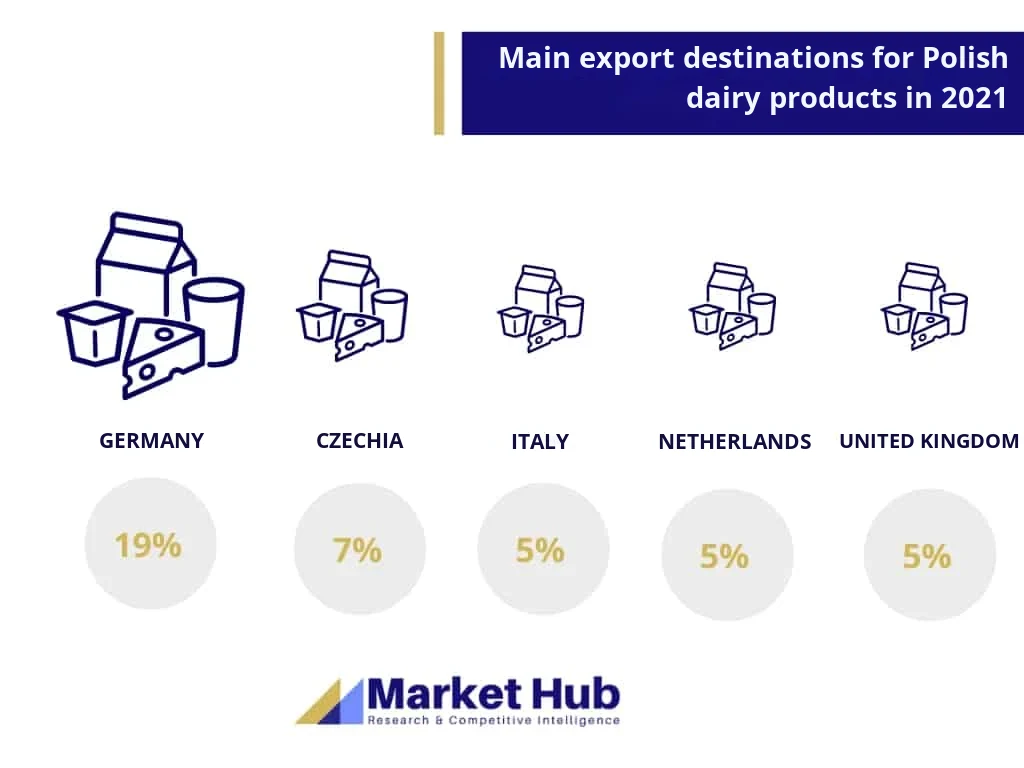
The main export destinations for dairy products from Poland in 2021 were: Germany (19% of value), the Czech Republic (7%), Italy (5%), the Netherlands (5%), the United Kingdom (5%), China (5%) and Algeria (4%).
What threats does the milk market in Poland face?
The main threats are Russia's aggression against Ukraine, which took 11% of Poland's cheese and curd cheese exports in 2021, rising inflation and rising energy costs.
However, Polish dairy processing faces risks, as many factors could disrupt it. One of them is Russia's aggression against Ukraine, which will certainly slow the pace of sales. Ukraine is an important trading partner for Poland, as 11% of our cheese and curd cheese exports in 2021 went there. Other factors affecting the milk market include constantly rising inflation (which may lead to lower consumption of dairy products) and rising energy costs, including gas and electricity. Moreover, as Marcin Hydzik, president of the Polish Association of Milk Processors (Związek Polskich Przetwórców Mleka), points out, if energy supplies to plants were cut for longer than 2–3 days, there would be a high risk of a serious crisis.
What trends are shaping the milk market in Poland?
Producers are responding to changing consumer expectations with clean labels, new flavours, reduced-allergen product lines and environmentally friendly practices.
Dairy producers respond to consumer needs. It is widely believed that economic or political turbulence will not become a serious threat to the dairy products market, given its stable position among food products. This position is rooted in consumers' belief that dairy products help prevent many diseases, boost immunity and have a probiotic effect. Even so, as in almost every area of our lives, some consumer preferences and expectations are changing here too. How are producers responding?
1. They put a blue drop with a white leaf symbol, meaning "Clean label", on their products. Customers are paying more and more attention to the list of ingredients and nutritional values, the country of origin and the production process. 2. They keep widening the range of flavours across their products, e.g. cheese spreads, yoghurts, desserts and even milk. 3. They create lines of reduced-allergen products. 4. They act in an environmentally friendly way, both in how they source raw materials and in packaging. This responds to the needs of consumers who prefer natural food. 5. They increasingly show the symbols of their certificates and attestations on packaging to highlight their contribution to environmental protection and to reducing their carbon footprint.
Author: Barbara Wargocka
Sources:
Ready-made market reports in PDF
Market Scan by MarketHub has ready-made PDF reports on selected markets: market size, key players, trends and data sources. If your market is not covered, we will prepare an in-depth market analysis.