

Photovoltaic market analysis in Poland
The MarketHub photovoltaic market brief is now available. See how this part of the renewable energy sector is performing.
Need ready-made market data? See the reports in Market Scan.
See the scan catalogue01
What is driving the photovoltaic market in Poland?
Photovoltaics in Poland is driven by CO2 emission regulations, subsidies for panel installations, the war and the need for energy independence, and the climate crisis.
The ongoing climate crisis and deteriorating air quality have made governments aware that the development of renewable energy sources is essential. According to data from the Chief Inspectorate of Environmental Protection (Główny Inspektorat Ochrony Środowiska, GIOŚ), poor air quality is particularly visible in cities. It affects both our health and nature. The war in Ukraine has shown all of us how important energy independence and a move away from fossil fuels are. Several factors are therefore driving the development of photovoltaics:
This part of the renewable energy sector is recording record growth in Poland, despite the market-driven turn towards fossil fuels before 2022. It also addresses problems that other countries face too. Our photovoltaic market brief will help you understand this complex situation.
02
How has the war in Ukraine affected renewable energy in Poland?
The war in Ukraine forced a renewed turn towards renewable energy, with Poland betting on wind farms and photovoltaics; in 2021, 65% of imported coal came from Russia.
According to Business Insider, in 2021, 65% of imported coal came from Russia. Although 80% of demand for coal was met from domestic sources, these are not inexhaustible. In addition, mines have a very negative impact on the environment (rock bursts, air pollution, methane explosions). The war in Ukraine forced a renewed turn towards renewable energy sources. As a lowland country that also struggles with hydrological drought and deforestation, Poland is betting on wind farms and photovoltaics. Solar panels can be installed on public buildings and also, for example, on single-family houses. That is why they are the most popular solution (biogas is second). The only problems are grid capacity, the sale of surplus electricity and the disposal of old installations.
03
How many solar installations are there in Poland?
According to the URE report, there are 3,056 installations using solar energy in Poland, out of 4,259 renewable energy installations in total (as at 31 December 2022).
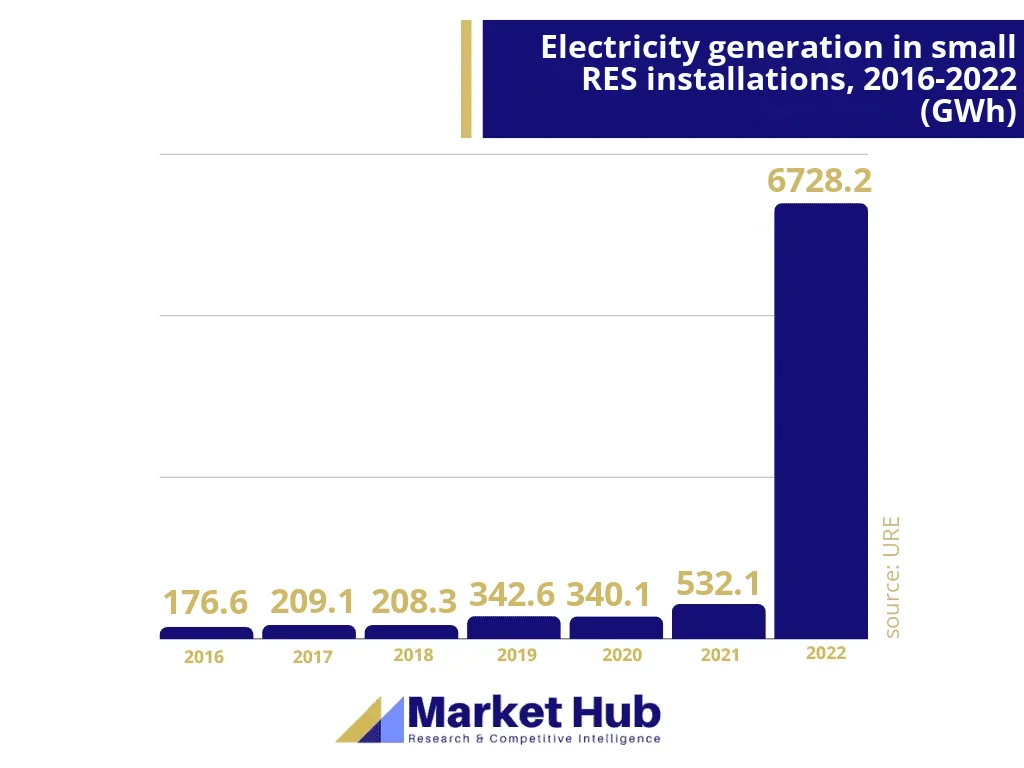
According to a report by the Energy Regulatory Office (Urząd Regulacji Energetyki, URE), there are 3,056 installations using solar energy in Poland (out of 4,259 renewable energy installations in total). They produced 2,491.873 MW of electricity out of 3,072.143 MW coming from renewable energy sources (as at 31 December 2022). Generators in small renewable energy installations (2,448 entities) produced more than 6,728 GWh of energy last year, of which they sold just over 42% (more than 2,821 GWh) to obligated sellers. Since 2016, the number of generators in small installations has increased sixfold. At that time there were 400 of them, and in 2022 there were already 2,400. Growth peaked in 2021–2022 because of carbon dioxide emission limits and the war in Ukraine.
04
What are the forecasts for the photovoltaic market in Poland?
According to IEO forecasts, another record increase of as much as 5.5 GW is expected in 2023, and by 2025 capacity should reach 27 GW.
Interest in photovoltaics is also influenced by the legal environment and the attractive system of feed-in premiums (FIP) and fixed feed-in tariffs (FIT). In 2022, small renewable energy installations produced a total of 6.7 TWh of energy. Most of the energy, more than 4.6 TWh, was generated in small photovoltaic power plants. That is as much as 69% of all electricity generated by renewable energy sources. According to forecasts by the Institute for Renewable Energy (Instytut Energetyki Odnawialnej, IEO), another record increase of as much as 5.5 GW is expected in 2023. By 2025, capacity should reach 27 GW. Even if prices fall, an investment in PV (photovoltaics) should pay for itself within 4–6 years. The industry is becoming increasingly professional. However, the model of the individual prosumer (someone who both produces and consumes energy) remains a challenge, as does selling surplus power in summer and making up for shortfalls in the winter months.
05
Can cable pooling solve Poland's energy crisis?
Cable pooling, using shared grid infrastructure for different energy sources, may be one solution, as the growth of renewable energy is being slowed by a grid that lacks capacity.
The climate crisis and the need to maintain energy independence are therefore forcing investment in renewable energy and in the prosumer model. In 2022, 1.2 m photovoltaic installations were installed, an increase of more than 41% y/y. Their total installed capacity reached more than 9.3 GW. Several factors unfavourable to renewable energy appeared at that time, such as price freezes and subsidies for fossil fuels, but they did not stop the industry. However, its development is being slowed by a neglected grid that is sensitive to changes in power and lacks capacity.
What is cable pooling?
One solution may be cable pooling, that is, using shared grid infrastructure for different energy sources instead of building separate infrastructure for each. This is particularly relevant in a country such as Poland, where sunshine and wind levels vary with the seasons. Wind farms and photovoltaics together produced 90% of the energy from renewable sources. Sharing energy infrastructure could therefore make good sense. As early as 2021, regulations were introduced allowing the connection of hybrid installations, i.e. installations using at least two renewable energy sources (according to Globenergia). Cable pooling is already working successfully in other countries, for example in Denmark and the Netherlands. Will it also work in Poland? Investing in the renewable energy industry is certainly worthwhile. According to the URE report, in 2022 90.233 MW came from hydropower, 75.110 MW from biogas, 403.320 MW from wind and 4.607 MW from biomass. Combined with 2,491.873 MW from photovoltaics, this offers interesting prospects for the future.
06
What are the prospects for the photovoltaic market in Poland?
By 2030, 27 GW in Poland is to come from photovoltaics, and the EU renewable energy target for 2030 has been raised from 27% to 45%.
The renewable energy target for EU countries for 2030 has been raised from 27% to 45%. By then, 27 GW in Poland is to come from photovoltaics. Across the EU, this is to be 600 GW. This is huge progress despite the reluctance of conservatives, and it is driven by environmental, economic and political reasons. Poland and Germany in particular have learnt how painful dependence on supplies from Russia is. If Poland continues its policy of supporting photovoltaics and wind farms, this may solve the problems of fossil fuel availability, environmental damage and political pressure, and also genuinely improve quality of life. Renewable energy therefore has a future, although many questions remain open. How can variable transmission levels and limited grid capacity be managed? How can solar panels be disposed of safely? Can they be produced more cheaply and quickly? There is still a lot of work ahead.
Author: Katarzyna Pokrywczyńska
Sources:
Ready-made market reports in PDF
Market Scan by MarketHub has ready-made PDF reports on selected markets: market size, key players, trends and data sources. If your market is not covered, we will prepare an in-depth market analysis.
Want to use this brief?
You can quote the data if you name the source and, where possible, link to our website. Use this credit line:
Source: MarketHub, "Photovoltaic market analysis in Poland", markethub.pl, 08.2023