

DIY market analysis in Poland
The term DIY ("do it yourself") has become very popular in recent years. The market for building and home improvement products, known as the DIY market, is growing.
The full report on this market in PDF, delivered in 3 business days.
Order the scan01
What does the DIY market include?
DIY means making, altering and repairing items yourself without professional help, and the term is usually associated with renovation and building goods, interior furnishings and garden products.
The term DIY has already become part of everyday language. It means making, altering and repairing various items yourself, without professional help.
The term is usually associated with the market for renovation and building goods, interior furnishings or garden products. However, it is also used to describe activities such as designing and making furniture and decorative accessories, repairing equipment yourself, home improvement, as well as handicrafts, e.g. sewing, knitting, crocheting, jewellery making or even cooking.
One of the most characteristic features of the DIY market is seasonality. Interest is noticeably higher in summer and winter. In summer, sales of live plants, lawnmowers and garden plants increase. In winter, and especially during the Christmas season, sales of all kinds of home decorations go up.
02
How big is the global DIY market?
The DIY market is estimated at USD 773.9 bn in 2023 and is expected to reach USD 915.26 bn by 2028, with a CAGR of 3.41%.
The outbreak of the COVID-19 pandemic had a positive impact on the home improvement market. When the government imposed nationwide lockdowns and travel restrictions, people were forced to stay and work at home. Social media and e-commerce platforms also helped to accelerate the growth of the market.
The size of the DIY market in 2023 is estimated at USD 773.9 bn. By 2028 it is expected to reach USD 915.26 bn, with a CAGR of 3.41% over the forecast period.
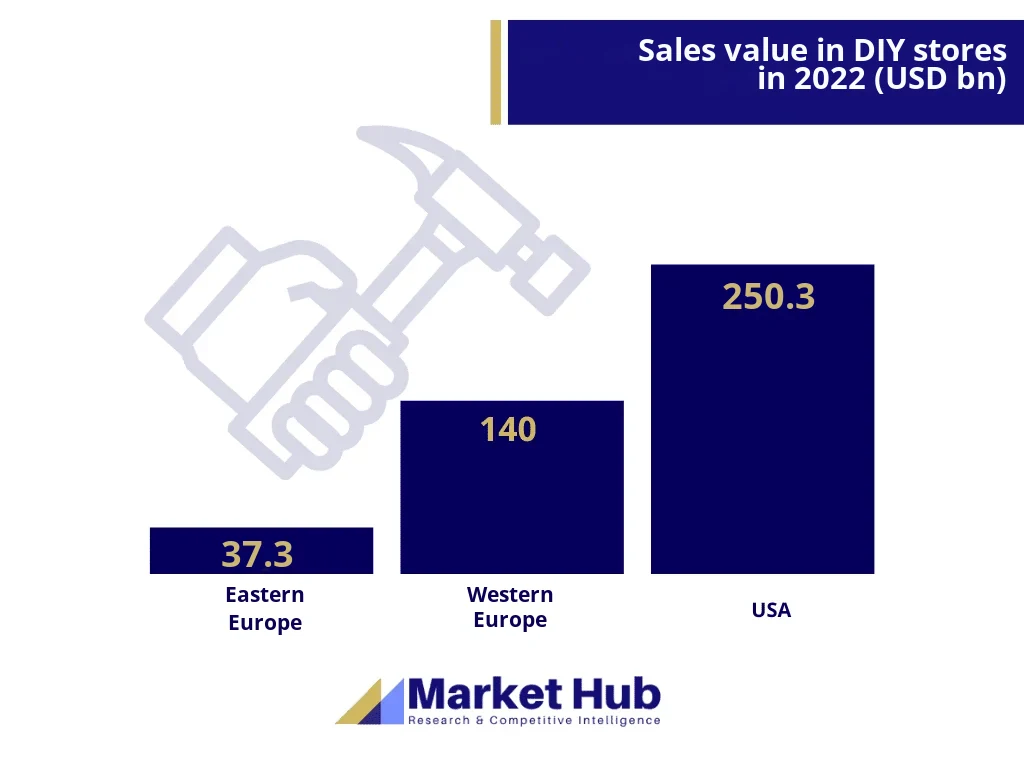
Retail sales in the home furnishings and garden stores market reached USD 665.6 bn globally in 2022. Taking inflation into account, this represents growth of 4%. DIY stores in Eastern Europe sold goods worth USD 37.3 bn, in Western Europe USD 140 bn, and in the USA USD 250.3 bn. In 2022 there were 1,033,752 stores of this type worldwide, of which 32,841 were in Eastern Europe.
Hand tools are an important part of the DIY market and make up a large part of the range of general building supply stores. Total sales in this category amounted to USD 13.7 bn, including USD 3.7 bn in Western Europe and "only" USD 528 m in Eastern Europe.
03
Who leads the DIY market in Poland?
Among DIY chains in Poland, the leaders are Castorama and Leroy Merlin, which together hold 56% of the DIY market.
There are currently almost 14 thousand stores with a DIY range operating in Poland. Distribution in the DIY segment consists of wholesalers and general building supply yards, building hypermarkets and supermarkets, and specialist stores. Among DIY chains, the leaders are Castorama and Leroy Merlin, which together hold 56% of the DIY market. A further 36% belongs to Obi, Mrówka and Bricomarche. The rest of the segment is made up of Merkury Market, Bricoman and other stores.
In the category of general building supply wholesalers and specialist stores, Grupa PSB and SiecBudowlana.pl clearly dominate, together holding 31% of the market. Grupa Handlo-Budowa, Majster Budowlane ABC, Grupa 3W, SIG and Grupa PHMB each hold a few percentage points of the market, as do the plumbing and heating wholesale chains BIMS Plus, Onninen and Grupa ABG.
04
What trends are shaping the DIY market?
The two main trends in the DIY market are recycling, i.e. modifying damaged or worn-out products, and upcycling, i.e. producing new items out of old ones.
Two main trends closely linked to concern for the environment can be observed in the DIY market. The first is recycling, i.e. modifying damaged or worn-out products. The second is upcycling, meaning producing new items out of old ones. The forecast growth is therefore linked above all to the rising number of people who follow a zero-waste lifestyle. As a result, DIY manufacturers focus largely on product safety, sustainability and efficiency, because hazardous chemicals and plastics pollute the environment once they are released into it.
Social media also matter to the DIY market. On TikTok, which has permanently changed the e-commerce market, the hashtag DIY has so far been viewed 388.4 billion times, and the hashtag DIYProject 38.6 billion times.
Authors: Aleksandra Sirant, Katarzyna Kucia
Sources:
DIY market in Poland
A ready-made PDF report from Market Scan by MarketHub: market size, key players, trends and data sources. We email it to you within 3 business days after payment.
Want to use this brief?
You can quote the data if you name the source and, where possible, link to our website. Use this credit line:
Source: MarketHub, "DIY market analysis in Poland", markethub.pl, 10.2023