













We show client names and logos only with their direct consent. Most of our projects are covered by a confidentiality clause.
Expert commentary in every report
Every market entry strategy includes comments from industry, scientific and business experts. They assess the recommendation, the entry mode, the costs and the risks before you take them to your board.
When do companies need a market entry strategy for Poland?
Companies order a strategy when they face a decision about a new market and want to base it on figures, not on impressions from a trade fair.
Poland is next in CEE
Your board is considering Poland as the next market in Central and Eastern Europe and needs to know whether, how and when.
Poland or a neighbour?
Your group strategy compares Poland with the Czech Republic, Romania or another market and needs one set of criteria for all of them.
The first attempt did not work
Your first distributor did not deliver. You need a diagnosis and a better way in before you try again.
A client asks about Poland
You are an adviser or an investment agency and need a reliable market chapter for your client.
What is a market entry strategy?
A market entry strategy is a report with a recommendation: whether your company should enter Poland, in what form, with which partners and in what order. It compares up to five markets against criteria agreed with your board, covers demand, competition, prices and channels, regulation and certification, an entry cost model in three scenarios and a plan of the first steps. Unlike a market analysis, it ends with a decision, not a description of the market.

How can a foreign company enter the Polish market?
Choosing the entry mode is often a bigger decision than choosing the country. This is how the most common options compare in Poland:
In the strategy we recommend one entry mode and one alternative. Many companies start with a cheaper mode, such as a distributor, and set up their own company once sales confirm the potential. If you already know you want a distributor, start with a distributor shortlist.

We research Poland in Polish.
Our analysts work with Polish registers and statistics and interview local distributors, importers and buyers in their own language.
How we reach a recommendation
The project starts with a workshop with your board, where we agree the decision criteria: how large a market has to be, how much you can spend on entry and how soon the investment should pay back. Every market is then scored against the same criteria, so you can see exactly where the recommendation comes from.
We compare two to five markets in one project: Poland and its neighbours, other EU countries including DACH and Scandinavia, Turkey or the USA. For each one we look at demand, competition, price levels and distribution channels, as well as regulation, certification and other barriers that could delay the launch. Entry costs go into a model with three scenarios, so the board can see how the result changes if sales go better or worse than planned.
At the end we state plainly whether to enter, how and with whom, and we discuss it at a second workshop with your board. The report, the cost model and the workshops are all in English. Projects take 4 to 8 weeks. We send the timeline and price within 72 hours, and the payment schedule is set in the contract.
How does Poland compare with neighbouring markets?
We score every market against the same criteria. We agree the weights with your board at the first workshop, so the ranking shows your company’s priorities, not ours. Example weights:
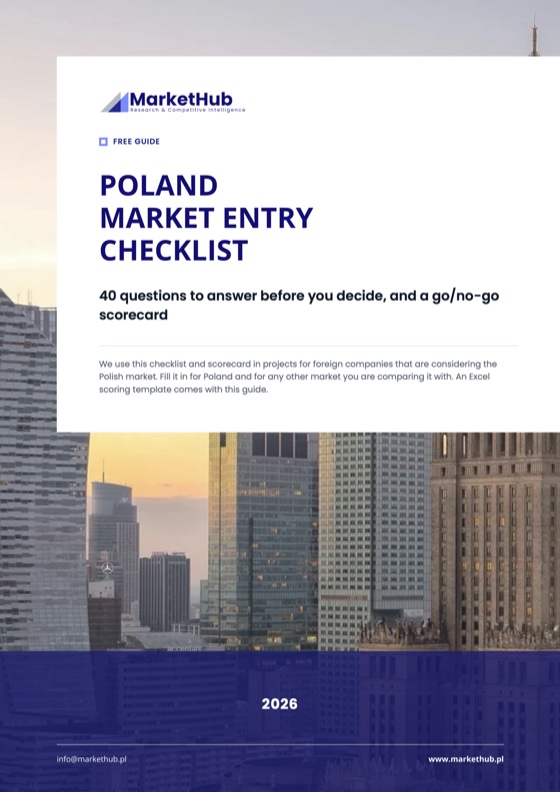
Get the Poland market entry checklist and the go/no-go scorecard
40 questions worth answering before you decide to enter Poland, a go/no-go scorecard and an Excel template to compare markets against weighted criteria.
- PDF: 40-question checklist and go/no-go scorecard
- XLSX: market scoring template
Enter your work e-mail and company name. We will send links to both files straight to your inbox.
How much does it cost to enter Poland?
That depends on your product and entry mode, so we calculate it for your case. You get the cost model in an XLSX file. The assumptions are explicit, so you can change them and see the result at once.

One-off costs
Registration, certification and product testing, translation and labels, sales materials, trade fairs, first stock.
Running costs
People, office or representative, warehouse and logistics, marketing, legal and accounting services.
Break-even
At what sales level and after how long entry starts to pay off.
Three scenarios
Cautious, base and optimistic: how the result changes when sales are lower or higher than planned.
EUR and PLN
We give amounts in EUR and PLN and show how the exchange rate affects costs, prices and break-even.
What does the report contain?
Examples of what the report covers. We agree the scope in the quote and at the first workshop.
Management workshops
We build the strategy together with your board, online or on site. That way the recommendation rests on criteria the board set itself.
Workshop 1: decision criteria
At the start we agree how large a market has to be, how much you can spend on entry and how soon the investment should pay back. You leave with a list of markets to compare and the criteria weights.
Workshop 2: recommendation
At the end we discuss the results: market ranking, entry mode, cost model and the plan of first steps. You leave with a decision and a task list.
Who should attend
The person who makes the decision and those responsible for sales or exports, finance and product. The fewer people you have to convince later, the better.
What you get
Every report is different, because we set the scope around your decision and your markets. The elements below are examples.
In what form:
How long does the strategy take?
A market entry strategy usually takes 4–8 weeks from accepting the quote. Timings are indicative. You get the exact schedule in the quote.
More markets, interviews in target markets and workshop dates extend the timeline.
What this does not cover
The strategy tells you whether and how to enter. These steps need other advisers:
Legal advice
Contracts, choice of legal form and regulatory opinions need a law firm.
Tax advice
VAT registration, customs and corporate tax questions need a tax adviser.
Company registration
You set up a Polish company or branch with a law firm or an accounting firm.
Recruitment
Hiring a local team needs a recruitment agency.
Our report lists the questions you should bring to these advisers.
Case studies

Three footwear manufacturers: Turkey
Three separate reports for producers of leather, orthopaedic and casual shoes: the market, the ten largest local manufacturers, standards and the recommended entry through a local distributor or representative. The same method works for Poland.
Read the case study
Steel structures producer
Demand forecast for steel structures in Poland to 2035 in three scenarios: energy, bridges, rail and industrial construction.
Read the case studyWe have worked on Poland, Turkey, the USA and the DACH countries. See more in our case studies.
Who will prepare your strategy
Our analysts prepare the research. You have one contact person throughout the project.

Patrycja Hrabiec-Hojda
Founded Infobrokerska in 2006, one of the first information brokerage firms in Poland, which grew into MarketHub. Has led analytical projects for 20 years and runs training in open-source intelligence (OSINT). Co-authored the professional standards for information brokers for the Polish Ministry of Labour.

Dr Łukasz Brzeziński
PhD in economics. Prepares advanced market reports and analyses. Assesses market potential, writes business plans and values technologies, patents and know-how.

Katarzyna Kucia
Prepares market analyses and reports, develops analytical materials and carries out desk research, including in scientific sources. Writes MarketHub market reviews and articles for the Rynek Informacji portal.
Too much? Not enough?
Are you an adviser, law firm or agency that wants to offer clients analyses under its own brand? See our offer for advisers.
Questions about entering the Polish market
Request a quote for a market entry strategy
Related: In-depth market analysis · Distributor shortlist · Market reviews · Case studies