

The silver economy: senior services market analysis
Poland faces significant demographic change which, in the coming decades, will bring new economic challenges and opportunities. The growing share of older people in society is driving rapid growth of the so-called silver economy, an economic system geared towards meeting the needs of seniors and making use of their consumer, health and social potential. According to forecasts, by 2050 one in three Poles will be over 60, which will radically change the labour market, consumption and services.
What is the silver economy and what is its market potential?
The silver economy is the market for products and services aimed at older people, usually over the age of 60, and forecasts assume that by 2060 the number of people aged 65+ will increase by more than a third.
As society ages, consumption patterns are changing significantly, and demand is growing for specialised goods and services tailored to the needs of different age groups. The silver economy (the senior economy) refers to the market for products and services aimed at older people, usually over the age of 60.
In 2023 the largest group in the senior population was people aged 65–69, accounting for 25.5% of this population. The smallest group was people aged 80–84 (7.9%). Forecasts assume that by 2060 the number of people aged 65+ will increase by more than a third, while the number of people aged 80+ will double.
How will the 65+ population in Poland change by 2060?
According to Statistics Poland (GUS) forecasts, in 2060 older people will make up as much as 34% of the country's population, with projections grouped into low, main and high scenarios.
The changing demographic structure of Europe, including Poland, is inevitably leading to a higher share of older people in society. According to forecasts by Statistics Poland (GUS), the number of people in this age group in Poland will be:
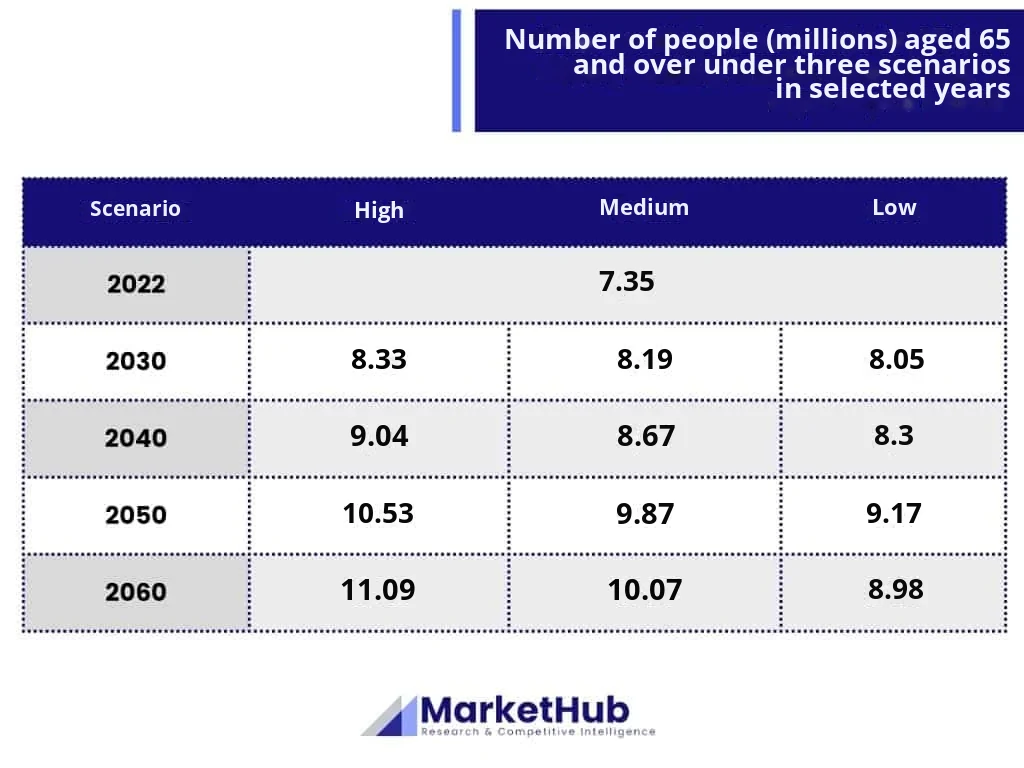
The individual variants have been grouped into three scenarios:
What are the key senior service sectors in Poland?
The main sectors of the silver economy are healthcare, long-term care, technologies supporting independence, education, and financial and advisory services.
The silver economy is growing rapidly and covers more and more areas of older people's daily lives. The main sectors are healthcare, long-term care, technologies supporting independence, education, and financial and advisory services. Research shows that seniors increasingly point to the need for better access to medical services (35.7%), opportunities for activity (28.3%) and financial stability (28.4%). At the same time, their use of new technologies and lifelong learning is growing. In response to these needs, services tailored to this group are developing, supported by public policies such as the act on the provision of social services by social service centres and the European Accessibility Act.
Healthcare and long-term care
The growing number of older people is generating ever greater demand for health services and long-term care. In Poland, the term "long-term care" refers both to nursing services within the healthcare system and to care services provided by social assistance. Currently, the biggest barriers reported by seniors are limited access to medical specialists, lack of rehabilitation and an insufficient number of day support centres. The proposed solutions also include less obvious measures, such as psychological support for lonely seniors or help with looking after pets during hospitalisation. In line with the European care strategy, member states, including Poland, should develop comprehensive, affordable care systems. Certificates such as "OK Senior" and the provisions of the EAA Directive are intended to improve the accessibility of services from 2025.
Rising demand for private long-term care facilities
The ageing of society and growing difficulties in accessing public medical care mean that more and more families are opting for private facilities providing long-term care. This applies in particular to seniors aged 85+, who most often require round-the-clock care, access to specialists and individually tailored rehabilitation. Because of the lack of sufficient public infrastructure and medical staff in many regions, especially rural ones, the private sector is becoming an important link in the support system for older people.
Development of home medical care and rehabilitation services
Home services, both nursing and rehabilitation, are playing an ever greater role in caring for seniors. Staff shortages, transport difficulties and the need to provide care in a familiar environment mean that support at the place of residence is gaining importance. Physiotherapy, preventive healthcare and support for people living alone are particularly important. At the same time, technologies such as telecare and e-health are developing and make remote health monitoring easier.
Recreation, culture and tourism
With growing health awareness, especially among "younger seniors" (aged 60–74), demand for active forms of leisure is rising. This segment covers fitness and wellness, tourism, culture, communication and entertainment. Tourism offers for seniors include holidays in the mountains and at the seaside, with access to healing thermal waters, spa treatments and rehabilitation. Rehabilitation stays in sanatoriums and holiday resorts are popular, often co-funded by PFRON (State Fund for Rehabilitation of Disabled Persons). These centres offer a wide range of treatments, such as cryotherapy, massages, water showers, light therapy and electro-water baths. In addition, holiday-season stays are organised.
What modern technologies are being developed for seniors?
The fast-growing age-tech market includes smartwatches and earphones with health features, smart home devices, advanced sensors and digital biomarkers.
The market for technologies for seniors, known as age-tech, is growing rapidly, driven by growing acceptance of technology among older people, especially after the COVID-19 pandemic.
What is the economic potential of seniors in Poland?
In 2023 the average monthly disposable income per person in households consisting solely of older people was PLN 3,009.69, with old-age or disability pensions accounting for 81.5% of it.
Only 42.1% of senior households rated their situation as good or fairly good, compared with 61.2% of households of younger people. In 2023 the average monthly disposable income per person in households consisting solely of older people was PLN 3,009.69. The main source of this income was old-age or disability pensions, which accounted for as much as 81.5%. Income from paid employment accounted for 9.7% of total income, and income from self-employment outside farming for 2.7%. Disposable income also varied with household size: PLN 2,981.52 for single-person senior households and PLN 3,013.65 for two-person senior households.
How economically active are older people in Poland?
In 2021 the economic activity rate among people over 50 was 35.6%. The highest economic activity rate in this age group was recorded among people aged 50–54 (83.4%). In 2023 seniors set up 35,000 businesses, which represented 12% of all registered businesses in Poland. On 1 June 2025 new regulations came into force that are intended to encourage employers to hire people over 50. The new rules provide for wage subsidies for companies employing workers from this age group, as a response to the challenges of an ageing society and labour shortages.
What are the challenges and opportunities for the silver economy in Poland?
The challenges for the silver economy in Poland are demographic, economic and social, while the opportunities come from growing demand, technological innovation and activating seniors.
The development of the silver economy in Poland is promising, but it involves several challenges, which at the same time open up new opportunities for innovation and investment.
Demographic challenges
The progressive ageing of society, including the phenomenon of "double ageing" (a growing share of the oldest seniors), and the rising old-age dependency ratio are a fundamental challenge. Fewer people of working age have to support an ever larger senior population, which puts a strain on public systems.
Economic challenges
Low public spending on long-term care compared with the EU average and the high cost of private services create gaps in availability. Many seniors, especially those living alone and in rural areas, assess their financial situation in a way that points to a problem with access to services, even if the segment's overall purchasing power is high.
Social challenges
An unbalanced system of informal care, in which families bear the main burden of care, leads to carer burnout. Age stereotypes in the labour market and digital exclusion limit seniors' activity and integration. The development of the senior economy requires state support through appropriate regulations, public policies and investment. Measures to educate society and build a positive image of old age are also needed.
Growing demand
The growing senior population and its considerable purchasing power create huge, untapped market potential. Seniors are increasingly aware consumers who are looking for products and services tailored to their needs and lifestyle.
Technological innovation
The development of age-tech, telecare and smart devices monitoring health and activity (smartwatches, SOS bands) offers new ways of supporting seniors' independence and safety. These technologies can also help reduce care costs and relieve carers.
Activating seniors
Making use of the professional and entrepreneurial potential of older people can benefit both seniors (additional income, social activity) and the economy (reducing the demographic burden, enriching the labour market with experienced workers).
Which accelerator programme invests in silver economy startups?
Next Age is the first accelerator programme in Europe that invests specifically in silver economy startups. The programme has already invested in 22 startups, which have raised more than EUR 8 m through direct investment and national and European grants. Startups from the third round include Bepi (a pill dispenser integrated with a digital platform), Rimborsiamo (a fintech platform specialising in interaction with senior customers) and Hippocraticum (an AI-based software solution designed to reduce doctors' administrative burden).
What is the outlook for the senior services market in Poland?
The senior services market in Poland is changing rapidly as the population ages, especially the oldest groups (80+), which increases the number of potential consumers and demand for care, health and technology services.
The senior services market in Poland, a key segment of the silver economy, is changing rapidly, driven by unprecedented demographic change. The Polish population is ageing rapidly, with a growing share of people aged 60+, and in particular of the oldest groups of seniors (80+), which is referred to as "double ageing". This trend increases the overall number of potential consumers and also changes the profile of their needs, shifting them towards more complex care, health and technology services.
Seniors in Poland have considerable purchasing power, as confirmed by data on their disposable income and share of consumption. However, their subjective assessment of their financial situation often differs from objective indicators, which points to the need to offer products and services with a varied price structure and to support social programmes. At the same time, seniors' growing economic activity and entrepreneurship, combined with their increasingly high level of education, are an untapped resource that can contribute to economic development and reduce the demographic burden.
Ready-made market reports in PDF
Market Scan by MarketHub has ready-made PDF reports on selected markets: market size, key players, trends and data sources. If your market is not covered, we will prepare an in-depth market analysis.