

Agricultural tractor market analysis: Poland and Europe
Although the pandemic had a negative impact on supply chains, the MarketHub analysis of the agricultural tractor market shows that sales of new tractors remain high.
Need ready-made market data? See the reports in Market Scan.
See the scan catalogue01
How have the pandemic and the war affected the agricultural tractor market?
In 2022 sales of new agricultural tractors decreased compared with 2021, although they remained high, and the BCI (Business Climate Index) fell from 36 to 24 points in March 2023.
In 2022, even agriculture felt the effects of the pandemic crisis. As a result, sales of new agricultural tractors decreased compared with 2021, although they remained high. This sector of the economy is feeling the effects of both the lockdown and the war in Ukraine, so results are not as good as they were just two years ago. The BCI (Business Climate Index) fell from 36 to 24 points in March 2023. Even so, despite rising prices of machinery and fuel, it is still at a relatively good level. However, 25% of companies assess the situation negatively, and 40% of the companies surveyed expect production to fall. The main causes are, of course, the war and drought, which is a symptom of the climate crisis.
02
Which European countries buy the most agricultural tractors?
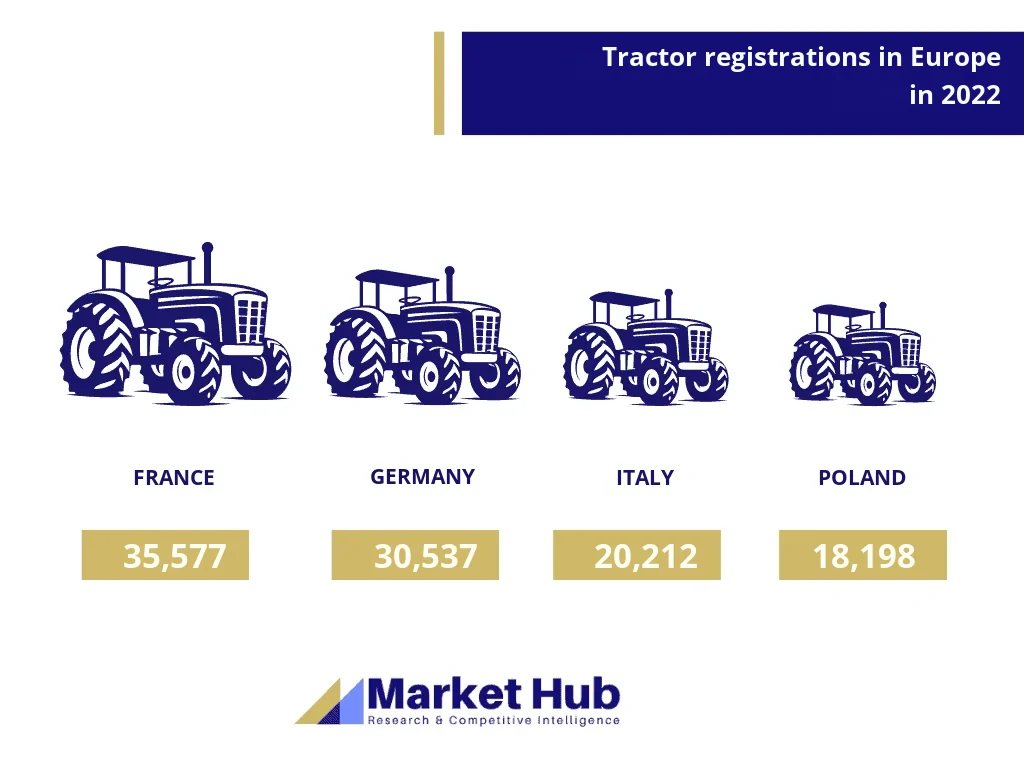
In 2022 France, Germany, Poland and Italy had the most new agricultural tractor registrations, with 40% of new tractors registered in Germany and France.
In total, more than 160,000 tractors were registered in 23 European countries in 2022. This means a decrease of 10% compared with the previous year and a return towards the long-term average. According to data published in Elibote magazine, in 2022 France, Germany, Poland and Italy were the countries with the most new agricultural tractor registrations. As many as 40% of new tractors in 2022 were registered in Germany and France. Although registrations remained high, the market recorded declines related to supply chain disruption and the war in Ukraine. Germany (-11%) and France (-1%) fared relatively best.
03
How many agricultural tractors were registered in Europe in 2022?
According to a CEMA report, 215,000 tractors were registered in Europe, almost 10% fewer than the previous year, so sales are still at a fairly high level.
According to a CEMA (European Agricultural Machinery Association) report, 215,000 tractors were registered in Europe. This number also includes vehicles that are formally classified as agricultural machinery only in some countries. Despite a decrease of almost 10% compared with the previous year, sales are still at a fairly high level. This is in rather unfavourable circumstances, such as rising prices and the war in Ukraine, which contributed to supply chain disruption.
04
How has supply chain disruption affected the agricultural tractor market?
There were problems with the timely delivery of components, and sales of low-power tractors (below 130 HP) fell by 15.2%, while 39% of tractors sold in 2022 were higher-power models.
The pandemic and Russia's attack on Ukraine have also affected agriculture. For example, there were problems with the timely delivery of components. The structure of farms has also changed. As a result, sales of low-power tractors (below 130 HP) fell by as much as 15.2%. European farmers prefer machines that work more efficiently. 39% of all tractors sold in 2022 were higher-power models. This is an increase of 3.7% compared with 2021. However, given the unfavourable circumstances, these figures may not reflect the real demand for new tractors. Now, in 2023, the situation may change. The pandemic has finally eased and there are no longer such difficulties with the supply chain. However, imports of agricultural produce or parts from the East may become a problem because of the war there.
05
Who leads the agricultural tractor market in Poland?
New Holland (1,550 units from January to October, 15.8% of the market) and John Deere (1,388 new registrations, 14.2% of the market) lead the tractor market in Poland.
Poland is one of the main exporters of apples and chokeberries. In 2022 exports of agricultural produce rose by 26.7% compared with the previous year, and their value amounted to PLN 223 bn. Polish cereals and dairy products go mainly to EU countries, above all Germany. This, together with the Common Agricultural Policy, pushes farms to modernise, including their machinery. Subsidies have made machines more affordable.
As always, New Holland and John Deere lead the market in Poland.
John Deere is clearly catching up with the leader in Poland and is keen to take first place. It was the only manufacturer to record sales growth in Poland. New Holland now faces a tough challenge, with a competitor close behind. And the stronger the competition in the market, the better for customers.
06
What risk factors affect the agricultural tractor market?
The main risk factors for agricultural tractor manufacturing are the climate crisis, the pandemic, the war in Ukraine and modern technologies.
Modern agriculture faces many challenges. Climate change, the geopolitical situation and constant technological progress are also changing the agricultural tractor manufacturing sector. Let us look at them one by one.
The greenhouse effect and drought will affect not only migration but also crop yields and the profitability of crop and livestock farming. Food prices are rising rapidly, and although inflation may have slowed somewhat, the situation is still far from favourable for consumers. More and more people will migrate. More people are also interested in eating less meat, which will change the structure of cereal, fruit and vegetable production. Vertical farms, for example, are attracting growing interest. Large, modern, multi-hectare monoculture farms, on the other hand, will modernise their machinery or buy new machines.
The pandemic also disrupted supplies. Climate change also means a greater risk of mass infections with viruses, bacteria and fungi. This in turn affects crop yields and the demand for tractors.
The outbreak of the war showed everyone how interconnected the economy is, and that this is very much "our business". Nobody knows how much longer the armed conflict with Russia will last or on what terms it will end. Its effects are already visible in the grain market. Poland currently has grain from its neighbour in storage, and at the same time, because of the war and drought, there are problems with sowing and insufficient yields. After the war, however, this may be an opportunity to expand to the East, because rebuilding the country will require a great deal of effort and resources.
The development of artificial intelligence has shown that low emissions will not be the only source of competitive advantage. Other features will also count, and in this field, too, an arms race is under way.
07
What is the outlook for the agricultural tractor market in Poland?
The pandemic and the war have reduced demand for tractors, and agriculture will no longer be a stable sector, requiring flexibility and innovation instead.
The pandemic and the outbreak of the war have also affected the agricultural machinery market. Demand for tractors has decreased. Agriculture will always be needed, but for obvious reasons it will no longer be a stable sector of the economy. Instead, it will require flexibility and innovation, not only at the design stage but also in ensuring continuity of supplies and storage. Will New Holland stay at the top in Poland? Or will the Green Deer outclass the leader? Time will tell.
Author: Katarzyna Pokrywczyńska
Sources:
Ready-made market reports in PDF
Market Scan by MarketHub has ready-made PDF reports on selected markets: market size, key players, trends and data sources. If your market is not covered, we will prepare an in-depth market analysis.
Want to use this brief?
You can quote the data if you name the source and, where possible, link to our website. Use this credit line:
Source: MarketHub, "Agricultural tractor market analysis: Poland and Europe", markethub.pl, 07.2023